76+Results SFFareBoxing SportsFanFare: Complete Guide to Boxing Results, Scores, and Fight Updates

The final bell rings. The crowd roars. You grab your phone and type one question: who won? That quick search for Results SFFareBoxing SportsFanFare starts a bigger story. A name alone won’t tell you how the fight ended. You also need the method, the score, and the record that follows. This Results SFFareBoxing SportsFanFare guide covers all of it in plain English. You’ll learn how to find SFFareBoxing results, decode boxing fight results, and spot weak pages fast.
What Is the Results of SFFareBoxing SportsFanFare?
Fans use Results SFFareBoxing SportsFanFare as a search phrase for fight outcomes. They hope to see the winner, the method, the score, and the updated record in one place. Think of it as a shortcut to SFFareBoxing boxing results and SportsFanFare boxing updates. Readers also expect boxing news and updates that explain what happened inside the ring. A bare name rarely does that.
Context changes everything. Picture two fights with the same winner. One boxer drops his rival in round one. Another squeaks through twelve tight rounds. Both count as wins, yet each tells a different tale. Complete boxing match outcomes carry that extra detail. The table below shows what a full entry usually holds.
| Part of a result | What it tells you |
| Fighter names | Who fought whom |
| Winner | Who took the victory |
| Method | KO, TKO, decision, or another path |
| Round and time | When the fight ended |
| Official score | How the judges saw each round |
| Date and venue | When and where it happened |
| Weight class | The division the boxers fought in |
| Title status | Whether a belt was at stake |
How to Find the Latest SFFareBoxing Boxing Results
Speed matters when a big card ends. Fans want the latest boxing updates within minutes. Still, a smart search beats a fast one. Start with the clues you already know. Maybe you remember a name or a month. Each clue narrows the hunt and saves time. That’s the core of how to check official fight results without stress.
Keep one rule in mind. Any single page can slip. A site might post a wrong score or miss a late change. So treat SFFareBoxing boxing results as a handy starting point. Then confirm the key facts with an official source. The three habits below make that routine simple.
Search for Boxing Results by Fighter Name
Type the boxer’s full name instead of a surname. Many fighters share last names across eras and weight classes. A full name cuts the noise. It also leads you straight to fight results by fighter name and a complete bout history. Add the word “results” or “record” for sharper hits. The database BoxRec keeps deep fighter pages that list every pro bout. Use it to check professional boxing records and compare them with what a news page says.
Check Fight Dates, Opponents, and Event Details
Can’t recall the boxer? Try the date or the rival instead. Even a rough month and year helps. The opponent’s name opens a second door to the same bout. You can also search the event page for the full card. One page may list ten bouts or more. That makes it a handy map of boxing event details. Note the boxing event date too. It separates a rematch from the first meeting and keeps you from mixing up similar fights.
Find Recent Results and Fighter Record Updates
Found the bout? Now check the fighter win-loss record before and after it. A boxer at 24-2-1 who wins should now sit at 25-2-1. If the numbers don’t match, you may have the wrong fight. This quick math check also reveals late edits. Next, scan the last five bouts. They show current form far better than a career total does. Fans looking for latest professional boxing results should always pair the headline with that short history.
How to Read Boxing Fight Results and Scores
Result lines look like code at first. Take this one: “Fighter A def. Fighter B, TKO, Round 7.” Three facts jump out. Fighter A won. The win came by technical knockout. The fight ended in the seventh round. Once you learn the shorthand, you’ll read boxing fight results in seconds. That skill is the heart of how to read boxing fight scores.
Scores add another layer. They appear when a bout goes to the judges. Quick stoppages usually skip that step. Knowing the difference saves you from hunting for numbers that don’t exist. The next four sections give you the tools to read both with ease.
Common Boxing Result Abbreviations Explained
Short codes keep result lines tidy. Learn these and you’ll follow almost every entry. A knockout (KO) means a boxer couldn’t beat the count. A technical knockout (TKO) means someone else stopped the bout. The remaining codes cover decisions and odd endings.
| Code | Meaning | What happened |
| KO | Knockout | A boxer couldn’t rise before the count ended |
| TKO | Technical knockout | The referee, doctor, or corner stopped the fight |
| UD | Unanimous decision | All three judges chose the same boxer |
| SD | Split decision | Two judges picked one boxer and one picked the other |
| MD | Majority decision | Two judges picked a winner and one scored a draw |
| TD | Technical decision | An accidental foul ended the fight and the judges scored it |
| DQ | Disqualification | A serious rules breach cost a boxer the fight |
| RTD | Retirement | A boxer or corner quit between rounds |
| NC | No contest | The fight ended without a normal win or loss |
Difference Between Fight Results and Fight Scores
The result is the verdict. The score is the evidence. A result might read “Fighter A wins by unanimous decision.” The boxing match scores then show the how, such as 116-112, 117-111, and 115-113. Both pieces matter when you study a close fight. The result says who won. The scores say how comfortably. That gap explains understanding boxing judges’ scorecards better than any long lecture could. Always read both before you form an opinion.
Understanding the 10-Point Must Scoring System
Most pro fights follow the 10-point must system. Judges score every round on its own. The round winner gets 10 points. The loser gets 9 or fewer. An even round can score 10-10. Judges weigh clean punching, effective aggression, defense, and ring generalship. This is how boxing scoring works in everyday terms. A twelve-round fight tops out at 120 points per judge. The boxing scoring system rewards winning rounds rather than total damage. So a boxer can lose more punches overall yet still take the decision.
Read More About: BD268XZ Explained: Ultimate Guide to Meaning, Uses, Benefits, and Future
How to Read Judges’ Scorecards, Knockdowns, and Point Deductions
A clean round goes 10-9. Knockdowns often push it to 10-8. A heavy beating with no knockdown can also earn 10-8. Point deductions hit a boxer who breaks the rules, such as with low blows or holding. The boxing referee decides when to take a point. Picture three judges’ scorecards that read 115-113, 116-112, and 114-114 after one deduction. That deduction may explain a tie on one card. Look for fouls whenever the math seems odd.
Understanding Boxing Outcomes: KO, TKO, and Decisions

Most fights end in a stoppage or a decision. That split shapes how fans remember a night. A stoppage feels sudden and final. A decision invites debate. Each path has sub-types. Stoppages split into KO and TKO. Decisions split into unanimous, split, and majority.
Some fights end in other ways. A draw, a disqualification, a technical decision, or a no contest can all appear. Learning every path helps you read boxing match outcomes like a pro. It also answers the difference between KO and TKO and the difference between split and majority decision. Let’s take them one by one.
Knockout (KO) and Technical Knockout (TKO)
A knockout (KO) happens when a boxer goes down and can’t beat the count. No judges are needed. A technical knockout (TKO) means someone else ended the bout. The boxing referee may step in if a fighter can’t defend himself. A ringside doctor may halt the fight over a cut. A corner may also throw in the towel. Both count as wins by stoppage. A line such as “TKO, Round 8, 1:42” even gives you the round number and the fight duration up to that moment.
Unanimous Decision (UD)
A unanimous decision (UD) means all three judges picked the same boxer. Suppose the cards read 118-110, 117-111, and 116-112. Every judge liked the same fighter. That usually signals a clear win. Still, a UD doesn’t always mean a one-sided fight. Three judges can agree on a narrow edge, such as 115-113 across the board. So read the margins. They tell you whether the winner dominated or merely edged ahead.
Read More About: 55+Crackstube Explained: Website Overview, Features, and Safety Guide
Split Decision (SD) and Majority Decision (MD)
A split decision (SD) means the judges disagreed. Two chose one boxer. One chose the other. The boxer with two votes wins. A majority decision (MD) sits between that and a unanimous call. Two judges pick a winner while the third scores a draw. Here’s a simple trick. In a split, the third judge picks the other boxer. In a majority, the third judge sees a tie. Both outcomes often follow close fights. They don’t prove that the result was wrong.
Draws, Disqualifications, and No-Contest Results
A draw is an official result. Neither boxer wins. It counts on the record as a draw. A disqualification in boxing happens after a serious foul, and the fouled boxer wins. A no-contest result means the fight didn’t produce a normal win or loss. An accidental foul early on or a failed drug test can cause it. If a foul ends the fight after the early rounds, judges may score what happened so far. That’s a technical decision. Think of a draw as a race that ended level. Think of a no contest as a race the officials threw out.
What Information Does a Complete Boxing Result Include?
A strong result answers many questions at once. Who fought? Who won? How did it end? When and where did it happen? Each answer adds a layer. Together they turn a plain line into a story. Use this section as a checklist for any page you read.
If a key piece is missing, treat the entry with care. Gaps often hide errors. Complete entries make official boxing results easier to trust. They also support deeper study of boxing statistics later on.
Fighter Names, Fight Outcomes, and Winning Methods
Start with both fighter names. Full names prevent mix-ups between boxers with similar names. Next, check the official fight outcome. A bout can end in a win, a draw, a no contest, or a disqualification. Each one changes the record differently. A DQ win still counts as a win. A no contest does not. Then read the method. A first-round KO hints at raw power. A tenth-round TKO may show grit and steady pressure.
Round Number and Fight Time
The round number and the exact time sharpen the picture. They tell you when the fight really turned. A stoppage at 0:45 of round one says something different from one at 2:59 of round ten. Compare these details across fighters to see who finishes early and who wears rivals down. Fans who track fight duration over several bouts often spot a boxer’s rhythm. Early finishers and late finishers carry different strengths into the ring.
Judges’ Scorecards and Official Scores
When a bout reaches the cards, the judges’ scorecards take center stage. Three judges score every round. You’ll see three totals, one per judge. Read all three rather than only the winner’s margin. A fight scored 117-111, 116-112, and 114-114 reveals a judge who saw it far differently. These boxing scorecards also help you judge how fair a decision looked. Stoppages usually have no final cards. Those fights end before the judges finish their work.
Weight Classes and Championship Details
Boxers fight inside set limits. The boxing weight divisions below show the classic caps. A fighter may move up or down during a career. So the division belongs in every result. Championship title fights raise the stakes and often run twelve rounds. The main sanctioning groups are the WBC, WBA, IBF, and WBO. Each one awards its own belt, which matters for championship boxing results.
| Weight division | Upper limit |
| Flyweight | 112 lb |
| Bantamweight | 118 lb |
| Featherweight | 126 lb |
| Lightweight | 135 lb |
| Welterweight | 147 lb |
| Middleweight | 160 lb |
| Light heavyweight | 175 lb |
| Cruiserweight | 200 lb |
| Heavyweight | Over 200 lb |
Event Names, Fight Dates, and Venues
The boxing event date and venue anchor a result in time. Rematches make this vital. Two boxers can meet twice in two years with very different outcomes. The event name also leads you to the full card. That opens the door to main event and undercard results. For older fights, the date may be the only clue that separates one entry from another. Strong boxing event details save you from reading the wrong bout.
Live Boxing Scores and Fight Updates on SportsFanFare

Live coverage moves fast. Live boxing scores often show round-by-round action, knockdowns, and the final verdict. Some feeds also show unofficial tallies from reporters. That’s how most live boxing score updates work. Fans on the other side of the world can follow along in real time. Speed is the big draw of SportsFanFare boxing updates.
Still, live feeds have limits. Early reports can contain slips. A typed score may differ from the final card. The ring announcer reads the true scores after the last bell. Wait for that moment before you trust a number. This simple pause makes your boxing match scores far more dependable.
Following Live Fight Updates and Result Changes
Good live fight updates share the round, the action, and any knockdown. Many also flag a cut, a foul, or a point deduction. Follow more than one feed during a big card. If two feeds disagree, hold your opinion for a moment. Late changes happen. A reporter may mislabel a knockdown as a slip, or a referee may revise a call after a review. Watch for a short notice that corrects the earlier line. Those small fixes show a careful page.
Difference Between Live Updates and Confirmed Final Results
A live update is a snapshot. A confirmed result is the final record. The gap between them can last minutes or even days. Official sources may adjust a score or a method after a review. So don’t share a number the moment you see it. Wait for the announcer’s read and a matching post from a trusted outlet. After that, check the fight result verification steps later in this guide. That habit protects you from spreading a wrong call.
SFFareBoxing Fight Schedules and Upcoming Matches
Results and schedules form one loop. Before the bout, fans want a date and a start time. After it, they want the outcome. The flow looks like this: scheduled fight, completed fight, official result, updated record. Knowing that loop helps you plan your viewing. It also helps you follow upcoming boxing matches with real context.
A solid listing of boxing fight schedules shows the date, venue, opponents, division, and broadcast details. Use it to build a watch list. Then return after the event for the official boxing results. That is the simplest answer to upcoming boxing fight schedules questions. It also ties the whole SFFareBoxing fight schedules habit together.
Read More About: 88+Afextop.com Review: Features, Categories, Benefits, and Safety Guide
Upcoming Fights, Dates, and Venues
Check three things for every listed bout. First, confirm the date and local time zone. Second, note the venue and city. Third, see who holds the broadcast rights. Time zones trip up fans all the time. A main event may start after midnight for viewers in another country. Look at the promoter’s page for the final start time. That page usually updates faster than a general listing site.
Main Events, Co-Main Events, and Undercard Bouts
A fight card has levels. The main event is the top attraction. The co-main event sits just below it. The undercard holds the rest. Many cards open with prospects and regional champions. Some of those names become stars later. So don’t skip the early bouts. Scanning full undercard results can reveal rising talent before the crowd catches on. It also gives you more boxing statistics to study.
Why Scheduled Boxing Matches Can Change
Fight dates shift more often than fans expect. An injury in camp can delay a card. A boxer may miss weight at the weigh-in. A promoter dispute or a sponsor issue can also derail a plan. Sometimes a late replacement steps in on short notice. These changes explain reasons boxing results may change in the lead-up too. Always check the promoter’s page on fight week. Treat any date as firm only after the weigh-in passes.
Connecting Upcoming Fights With Recent Results
Past results help you size up the next bout. Compare each fighter’s last three to five outings. Look at who they beat and how they won. A boxer on a knockout streak may carry power into the ring. Another with several narrow decisions may rely on skill and stamina. This is fighter performance analysis in a simple form. It turns a schedule into a story you can predict.
How Boxing Results Affect Fighter Records and Rankings
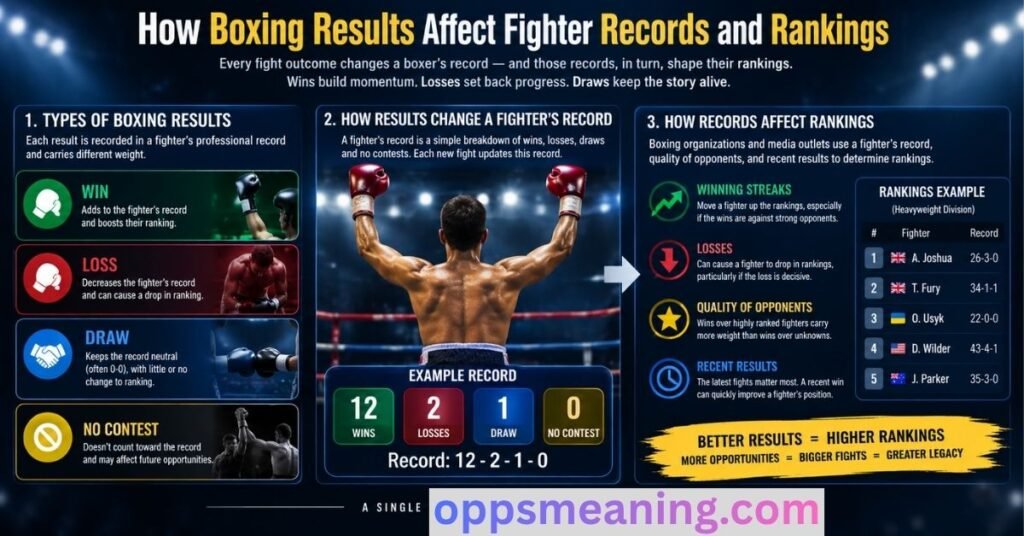
Every official fight rewrites a boxer’s story. A win lifts the record and builds momentum. A loss can drop a fighter several places. Promoters and fans watch these swings closely. That’s the idea behind how boxing results affect fighter rankings.
Records and rankings move together but not in lockstep. A smart win over a top contender can lift a boxer fast. A sloppy win over a weak rival may barely move the needle. So numbers alone never tell the full tale. The sections below show how each piece works.
Understanding Wins, Losses, and Draws
A pro record lists wins, losses, and draws in that order. Take 24-2-1. That means 24 wins, 2 losses, and 1 draw. Knockout wins often appear in brackets beside the total. A new win turns 24-2-1 into 25-2-1. A loss makes it 24-3-1. A draw makes it 24-2-2. A no contest usually adds a separate tag and leaves the three main numbers alone. This is exactly how professional boxing records change after each card.
What Knockout Percentages Reveal About Fighters
Knockout percentage shows how often a boxer finishes fights. Divide knockout wins by total wins. A boxer with 20 wins and 15 by KO has a 75 percent rate. That number hints at power. Yet it has limits. A high rate against weak opponents means little. Pair it with opponent quality and recent form. Together they make fighter records and performance statistics much more useful than a single percentage.
Read More About: TheJavaSea.me Leaks AIO-TLP371: Facts, Risks, and Safety Guide
How Recent Performances Influence Fighter Rankings
Rankings lean on recent form. Groups and magazines weigh the quality of the opponent and the manner of the win. Outlets such as The Ring publish their own lists. Sanctioning bodies publish theirs. Lists often differ. That’s normal because each uses its own method. To see how boxing rankings reflect form, track the last three to five bouts. They show whether a boxer is rising or fading. Trustworthy fighter rankings follow that trend.
Championship Titles, Rematches, and Ranking Changes
Titles shake up rankings fast. A new champion jumps to the top of the division. A beaten champion often drops but may stay near the top. Many bodies name a mandatory challenger who must fight the champion within a set time. A belt can also be vacated when a boxer moves up or refuses a required bout. Rematch clauses add another twist. They give a beaten champion a quick shot at revenge. Follow these moves to read boxing championship results and rankings with care.
How Accurate and Reliable Are SFFareBoxing Results?
Accuracy matters because records last for years. One typo can follow a fighter through a whole career. So ask a fair question about any site. How does it get its data? Can you trace it to a source? Pages with named sources and clear dates earn more trust. Pages with no sources deserve extra caution. That includes Results SFFareBoxing SportsFanFare pages. Treat them as a convenient guide. Then confirm anything important.
Good habits protect you. Compare at least two sources for big fights. Look for matching names, scores, and times. Check the date too. If two sources disagree, dig deeper. This is the core of reliable sources for boxing results. The next three sections explain why changes happen and how to verify a result.
Why Boxing Results May Be Updated or Corrected
Most results stay put. Yet changes do happen. A scoring error may get fixed after a review. A failed drug test can turn a win into a no contest. A commission may overturn a result on appeal. Early reports can also mislabel the method of victory. These cases explain why boxing results may change matter to careful fans. The final official boxing results always beat early social posts.
How to Verify Results With Official Boxing Organizations
Strong fight result verification takes only a few minutes. First, open the boxer’s page on BoxRec. Next, visit the sanctioning body that covers the belt, such as the WBC or WBO. For commission records in the United States, check the Association of Boxing Commissions. Then compare the winner, method, round, and scores. This routine answers how to verify boxing match outcomes with confidence. Matching details across sources are a strong sign of accuracy.
Checking Promoters, Event Details, and Weight Classes
Promoter pages often post the first official card and the weigh-in report. Use them to confirm the date, venue, and each boxer’s weight. A missed weight can change a title status. For example, a champion who misses the limit may lose the chance to keep a belt even with a win. Compare the weight on the result page with the weigh-in report. Any mismatch deserves a second look. Those small checks protect the quality of your boxing event details.
How to Evaluate a Boxer Beyond Wins and Losses
A record is a headline. It isn’t the whole story. Two boxers can both hold a 20-1 mark. One may have beaten former champions. The other may have faced weaker names. The numbers look the same. The paths do not. Smart fans dig under the surface. That’s the idea behind evaluating boxers beyond wins and losses.
Good analysis blends several clues. Look at opponent quality, recent form, and style. Add boxing statistics such as knockout rate and activity. Include punch stats when they’re available. Together, these clues give a fuller view than any single number. They also help with interpreting boxing match statistics in a careful way.
Performance Trends and Quality of Opponents
Trends reveal momentum. A boxer who wins three straight against ranked rivals is climbing. One who struggles against modest names may be slipping. Quality of opposition is the key filter. Check the weight division too. A jump up or down can change a fighter’s power and speed. Study the fighter performance analysis over several years. Patterns appear in how a boxer starts, finishes, and handles pressure.
Close Fights and Controversial Decisions
Some fights split the room. Consider the first Canelo Alvarez and Gennady Golovkin fight in 2017. It ended in a draw. One judge scored it 118-110 for Alvarez. Another scored it 115-113 for Golovkin. The third had it level at 114-114. Fans argued for months. A rematch followed in 2018, and Alvarez won by majority decision. This case shows that controversial boxing decisions often come from many close rounds. To judge them, read all three cards. Count the close rounds. Note any knockdowns and weigh ring control.
Punching Accuracy, Defense, and Ring Generalship
Punch stats show who landed more clean shots. Defense shows who avoided damage. Ring generalship means control of distance, pace, and position. A boxer who dictates all three often wins rounds even without big punches. Compare landed punches with thrown punches to measure accuracy. Then watch how often a boxer gets hit in return. These details power strong boxing statistics reading and explain why some winners look better on cards than in the stats.
Common Mistakes to Avoid When Reading Boxing Results
Even seasoned fans slip up. Boxing has plenty of similar terms. A small mix-up can change the meaning of a whole result. The good news is that most errors are easy to fix. A few simple habits go a long way. The table below sums up the main traps.
| Mistake | Better habit |
| Treating KO and TKO as the same | Check who ended the fight |
| Reading only the winner | Check the method, round, and scores |
| Skipping the scorecards | Compare all three judges |
| Mixing up draw, DQ, and no contest | Learn how each affects the record |
| Ignoring the date | Match the date to the right bout |
Each mistake has a deeper cause. Rushing is the biggest one. Fans see a headline and move on. A slower look pays off. Spend thirty extra seconds on the details. That small pause makes your reading of boxing fight results far sharper.
Confusing Knockouts With Technical Knockouts
Both end in a stoppage. Yet they differ in how the fight stops. A KO means the boxer failed to beat the count. A TKO means the referee, doctor, or corner stepped in. The difference affects how you judge a performance. A TKO from a doctor’s call after a cut says something different from a clean KO. Always read the full result line. It tells you who stopped the bout and when.
Ignoring Judges’ Scorecards and Round Details
A bare “won by decision” hides plenty. The cards show whether the win was easy or razor-thin. A 119-109 card says “dominant.” A 115-113 card says “close.” Round details matter too. A late knockdown can swing a card. Skipping these facts means missing half the story. Strong readers of boxing scorecards always check the margins and the round-by-round totals when they exist.
Mixing Up Draws, Disqualifications, and No Contests
A draw is a finished fight with no winner. A disqualification gives the win to the fouled boxer. A no contest sets the fight aside. Many fans swap these terms. That leads to wrong record math. A DQ win adds a win. A draw adds a draw. A no contest usually leaves the main record untouched. Keep this order in mind and your fighter win-loss record math will stay clean.
Overlooking Fight Dates and Record Changes
Boxers fight more than once. So an old result can pass for a new one. Always check the date. Then check the record change. A fighter’s total should move by exactly one step after each bout. If it jumps oddly, something is off. This habit protects you when you study professional boxing records across many years.
How to Use SFFareBoxing Results for Boxing Research
Results are raw material for research. Casual fans use them to settle a debate. Analysts and writers use them to build full profiles. Students of the sport trace a career from the first pro bout to the latest title fight. Each group asks different questions. Yet all of them start from the same facts. Pages tied to Results SFFareBoxing SportsFanFare can serve as a starting point for that work.
A useful research routine has clear steps. Build a timeline of opponents, methods, title fights, and long layoffs. Patterns pop up fast. Then blend the record with championship boxing results and boxing statistics for a rounded view. Over time, you’ll form your own sense of performance trends. That skill turns a casual viewer into a sharp observer. The table below lays out a simple five-step plan.
| Step | Action | Goal |
| 1 | Gather the full record | See every fight in order |
| 2 | List opponents and methods | Judge the quality of wins |
| 3 | Mark title fights and rematches | Spot career peaks |
| 4 | Note layoffs and weight changes | Explain dips in form |
| 5 | Verify key bouts with two sources | Confirm accuracy |
Frequently Asked Questions
What Does SFFareBoxing SportsFanFare Results Mean?
The phrase points to boxing outcome information linked with SFFareBoxing and SportsFanFare coverage. It covers winners, methods of victory, scores, fighter records, and event details. Because site details can vary, confirm key facts with an official source before you share them.
Where Can I Find the Latest SFFareBoxing Boxing Results?
Search by the boxer’s full name or by the event date. Add the opponent’s name for sharper results. Then check the record before and after the bout. Confirm the final outcome on a trusted database such as BoxRec.
Does SportsFanFare Provide Live Boxing Scores?
Many sports pages offer live boxing scores and round-by-round updates. Availability can vary by event. Treat unofficial tallies as temporary. Wait for the ring announcer’s read and a matching official post before you rely on any number.
What Is the Difference Between a KO and a TKO?
A KO happens when a boxer can’t rise before the referee finishes the count. A TKO happens when the referee, doctor, or corner stops the fight. Both end the bout early. Only the way it stops differs.
What Is the Difference Between a Split Decision and a Majority Decision?
In a split decision, two judges pick one boxer and the third picks the other. In a majority decision, two judges pick a winner and the third scores a draw. In both cases, the boxer with two votes wins.
Does a Unanimous Decision Mean a One-Sided Fight?
No. A unanimous decision only means all three judges picked the same boxer. The margins can still be tight. Three cards of 115-113 show agreement on a close fight. Always read the scores for the full picture.
Can Official Boxing Results Change After a Fight?
Yes, though it’s rare. A scoring error, a failed drug test, or a commission appeal can change a result. A win may turn into a no contest. Always check for later notices on official pages.
Is a No Contest the Same as a Draw?
No. A draw is an official result with no winner. A no contest means the bout doesn’t count as a normal win or loss. They lead to different record changes, so keep them apart.
Where Can I Verify Official Boxing Fight Results?
Check a major boxing database, the promoter’s event page, and the relevant commission or sanctioning body. Compare names, scores, rounds, and dates across sources. Matching details are a strong sign of accuracy.
Conclusion
Results SFFareBoxing SportsFanFare works best when you look past the winner’s name. The method, the round, the scores, the weight class, and the date all shape the real story. Add the updated record and the quality of the opponent. Now you have a full picture of what happened in the ring.
Keep the key tools close. Learn the abbreviations. Compare boxing scorecards. Verify big results with more than one source. Track recent form before you judge a matchup. Do all that and you’ll read SFFareBoxing boxing results with confidence. Next fight night, you’ll know far more than who won.

Ethan Brooks is a language writer who shares simple explanations of word meanings, grammar, phrases, slang, and everyday expressions. His goal is to make confusing language easy to understand with clear and helpful information.