Research Dossier for Target Company: Effective AI Research Guide (2026)

One wrong assumption about a company can sink a deal. A flashy website might hide weak finances. A quiet startup might hold a rare product edge. A research dossier for target company work shows you which story is true before you spend money or time.
This guide covers a clear process, trusted sources, and ready-made prompts. You will also see tool comparisons and a full checklist. Every part uses plain words and short sentences. You can follow along even if you have never done target company research before.
What Is a Research Dossier for a Target Company?
A research dossier for target company work is a structured report about one business. It gathers facts from many places and checks them for accuracy. Then it adds analysis so you know what the facts mean. Think of it as a detective’s case file for the business world.
Many people use these files. Sales teams use them to find buyers. Investors use them to judge risk. Agencies use them to plan pitches. Job seekers use them to size up employers. Procurement teams use them to screen suppliers. Each group wants the same thing: evidence-based business decisions instead of guesses.
Research Dossier vs. Company Profile
A profile is a snapshot. A dossier is a full investigation. A short company overview tells you what a firm does. A dossier goes further and tests claims, compares rivals, and flags risks. The table below shows the gap.
| Feature | Company Profile | Research Dossier |
| Depth | Light summary | Deep analysis |
| Purpose | Quick awareness | Decision support |
| Sources | One or two | Many, cross-checked |
| Analysis | Rarely included | Always included |
| Risk review | Missing | Built in |
Company profile analysis is a good first pass. However, a dossier gives you the proof you need for bigger choices.
Common Business Use Cases for Company Research
Teams run corporate research for many reasons. Sales reps use business prospect research to personalize outreach. Investors use investment research analysis to weigh returns against risk. Partnership teams study fit and trust before they sign anything. Buyers run a vendor evaluation process to avoid unreliable suppliers. Marketers track rivals to spot shifts early. Job hunters read between the lines of career pages. Each use case needs a slightly different focus. The core method stays the same.
Why Is Target Company Research Important?
Research saves money. It also saves time and stress. A few hours of company background research can prevent months of regret. You learn who the company serves and how it earns money. You also learn where trouble might hide.
A polished website tells only one side. Anyone can buy a nice design. The real business shows up in filings, reviews, job posts, and news. Good business intelligence blends all of these sources into one clear picture. That picture helps you act with confidence.
Identify Business Opportunities
Research reveals gaps you can fill. Maybe a software firm has great tools but weak guides. Maybe it ignores a whole region or industry. That gap is your opening. This is market opportunity identification at work. A marketing agency might spot missing comparison pages. A supplier might see a product line with no strong partner. Always check demand before you pitch. A gap only matters if buyers care about it.
Understand Competitors and Market Position
No company stands alone. Every firm has direct rivals who sell the same thing. It also has indirect rivals who solve the same problem differently. A smart competitor analysis maps both groups. This competitive landscape assessment shows pricing, features, and brand voice side by side. It also shows who leads and who trails. Use market position analysis to learn whether your target is a leader, a challenger, or a niche player.
Reduce Business Risks
Hidden problems cost real money. A business risk assessment looks for warning signs early. These include legal disputes, unstable finances, and sudden leadership exits. They also include fake claims and copycat domains. This is business risk identification in practice. Spotting a red flag before signing is far cheaper than fixing it after. For large deals, add legal and financial checks to your website research.
Improve Sales and Marketing Outreach
Generic messages get ignored. A researched message gets read. Imagine you know a firm just launched an enterprise plan. You can open your email by mentioning it. That shows effort and respect. A solid sales prospecting strategy starts with facts like these. The reader feels understood. Replies go up as a result.
What Should a Research Dossier for a Target Company Include?
A strong dossier has fixed sections. Each section answers one big question. Together they form a complete business research report. The table below gives a quick map.
| Section | Main Question |
| Company overview | Who are they? |
| Business model | How do they earn money? |
| Audience and market | Who buys from them? |
| Competitors | Who else competes? |
| Leadership | Who runs and owns it? |
| Financials | Is it healthy? |
| Technology | What do they build? |
| Online presence | How do people see them? |
| News and trends | What changed lately? |
| Risks and SWOT | What could go wrong? |
| Findings | What should you do next? |
Every section needs two things. First, add a source link. Second, add the date you checked it. Facts go stale fast. A dated source lets readers judge freshness. This habit turns notes into a trusted company research report template.
Company Overview and Business Information
Start with the basics. Record the legal name and the trading name. Add the official website, industry, headquarters, and founding year. Note the number of employees if a reliable source gives it. This company overview anchors everything else. If two firms share a similar name, the legal registration number helps you tell them apart. Mark any missing detail as unknown. Never fill gaps with a guess.
Business Model, Products, and Services
Explain how the firm makes money. Does it sell subscriptions, one-time products, services, or ads? The company business model shapes its whole strategy. Next, list the company products and services in plain words. Note the pricing style and the main selling points. A subscription tool for freelancers works very differently from a custom contract for banks. Look at limits too. Every product has weak spots.
Target Audience and Market Analysis
Next, find out who the company serves. Read its website copy and case studies. Look at the industries and regions it names. Careful target audience analysis separates the customers a firm wants from the customers it has. Marketing pages show hopes. Named customer stories show reality. Add a note on market size and growth when a trusted source supplies it.
Competitor Research and Competitive Intelligence
List three to five rivals. Compare price, features, content, and reviews. This is competitive intelligence research. A simple table keeps it neat.
| Area | Target Company | Rival A | Rival B |
| Starting price | Add data | Add data | Add data |
| Key strength | Add data | Add data | Add data |
| Weak spot | Add data | Add data | Add data |
| Content depth | Add data | Add data | Add data |
Look for patterns. If every rival offers a free trial and your target does not, that matters.
Leadership, Ownership, and Key Decision-Makers
People steer companies. Study founders, executives, and board members. Check their past roles and public interviews. This leadership background investigation shows strategy and experience. Also map company leadership and ownership. Learn who holds shares and who controls votes. A new chief technology officer may signal a product push. A string of quick exits may signal trouble. Treat these as clues rather than proof.
Financial Performance, Funding, and Growth Signals
Money tells the truth. Public firms file reports with regulators. Private firms share less. Do company financial research with revenue, profit, debt, and funding rounds. This financial health evaluation shows whether the firm can survive a bad year. Run financial performance analysis across several years instead of one. Also watch business growth signals. New offices, rising job posts, and fresh partnerships often point to expansion. Missing data does not equal bad health. Many private firms simply stay quiet.
Read More About: FRABOC Explained: Risk Categories, Purpose, and Alternatives in 2026
Technology, Patents, and Innovation
Innovation shows where a company is heading. Check its tech stack, product updates, and open roles. Then run patent and innovation research. Patent filings reveal what the firm is building before launch. They also show how serious its research work is. A company with many filings in one field may plan a big move there. Pair this with product release notes for a fuller view.
Online Presence, SEO, and Brand Reputation
A firm’s digital footprint shows how it talks to buyers. Review its blog, social profiles, and search visibility. Third-party SEO tools give estimates only. Treat them as rough guides. Use online brand reputation monitoring to read reviews and mentions over time. Judge company reputation and trustworthiness by repeated themes. One angry review means little. Twenty similar complaints mean a lot. Google’s SEO Starter Guide helps you read a site’s search setup.
Recent News, Developments, and Industry Trends
Fresh news shows what is changing now. Search for launches, deals, hires, and legal events. Write the publication date next to each item. Then label it clearly. An announced plan is not a finished event. A firm may promise a new market but never enter it. Also scan the wider industry. Trends such as new rules or new tech can lift or hurt your target.
Risks, Red Flags, and SWOT Analysis
Now pull the findings together. A SWOT analysis sorts them into four boxes.
| Strengths | Weaknesses |
| Loyal users, easy product | Thin reporting features |
| Opportunities | Threats |
| Enterprise market, new content | Bigger rivals, price pressure |
Add a red flag list beside it. Typical flags include copied text, hidden ownership, unpaid bills, and fake reviews. A clear company risk assessment ranks each issue by impact and likelihood.
Key Findings and Recommended Next Steps
End with action. Summarize the three to five biggest findings in plain words. Then state what to do next. You might book a call, request more documents, or walk away. Add open questions that still need answers. This closing section turns actionable research insights into a clear plan. Busy readers often read only this part first.
Which Sources Are Best for Target Company Research?
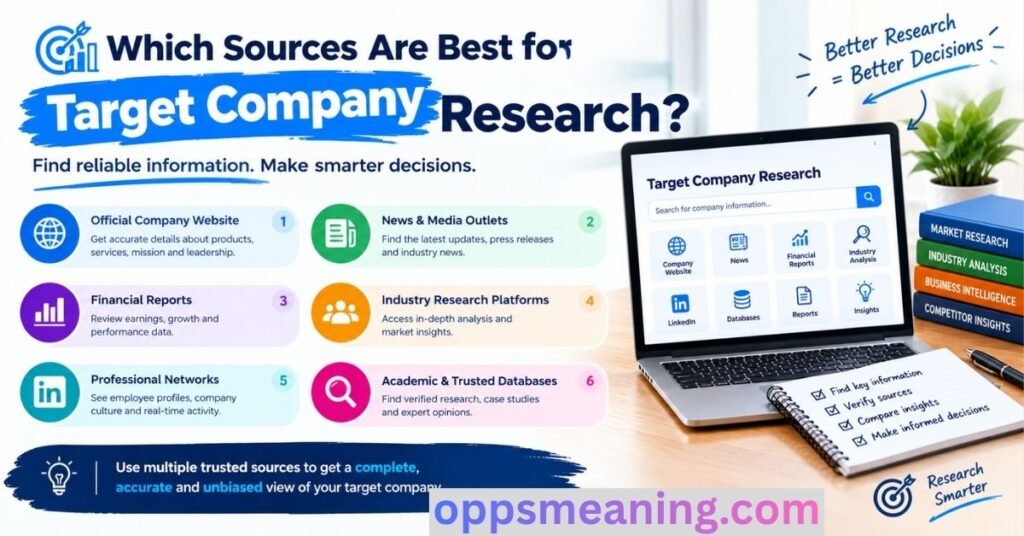
Good research needs good sources. Rank them by trust. Primary sources come straight from the company or a regulator. Secondary sources interpret those facts. User-generated sources show public opinion. Smart primary and secondary research sources work together. Each one fills a hole the others leave.
Always label the source type in your notes. The table below shows the best use of each type. Pick reliable business information sources first. Use softer sources only to spot patterns.
| Source Type | Best For | Trust Level |
| Company website | Products, pricing, claims | Medium |
| Regulatory filings | Financial facts | High |
| Business registries | Legal status, directors | High |
| News outlets | Context and events | Medium to high |
| Job listings | Growth and tools | Medium |
| Patent databases | Innovation signals | High |
| Reviews and forums | Customer sentiment | Low to medium |
Official Company Websites and Investor Relations Pages
The official site is your first stop. It shows products, prices, leaders, and press releases. Official company website verification matters here. Confirm the legal name, contact details, and policy pages. Public firms also run investor pages with reports and earnings calls. Remember one rule. The site shows how the company wants to look. Check bold claims elsewhere.
Business Registries and SEC EDGAR Filings
Registries hold legal facts. In the United States, the SEC EDGAR database stores filings from public firms. These SEC EDGAR company filings include annual reports and risk disclosures. In the United Kingdom, Companies House lists directors and accounts. For many other countries, OpenCorporates offers a wide search. Registry data helps confirm that a firm truly exists.
Reputable News Outlets and Industry Publications
News adds context. Trusted outlets check facts before they publish. Industry magazines explain trends that general papers miss. Look for stories about funding, lawsuits, and leadership moves. Always read the date. An old story can mislead you. Compare two outlets when the news is big. Different angles often reveal more.
Read More About: Deshoptec Com: What It Is, How It Works, and Is It Safe? (2026 Guide)
Job Listings and Hiring Announcements
Job posts act like a window into plans. A burst of sales hires may signal a growth push. Many data roles may signal a tech shift. Listings also name tools the firm uses. A sudden drop in hiring may hint at cost cuts. Check careers pages and professional networks. Treat the pattern as a clue and never as proof.
USPTO and Google Patents
Patents show future ideas. Search the USPTO for United States filings. Use Google Patents for a broader global view. Espacenet also covers many regions. Look at the filing date, the topic, and the named inventors. Filing a patent does not guarantee a product. Still, the trend tells you where money and talent flow.
Review Platforms, Forums, and Social Media
Customers speak freely online. Review sites, forums, and social posts reveal real pain points. Look for repeat complaints and repeat praise. One loud voice proves little. A steady chorus proves a lot. Beware of fake reviews. Odd timing, copied phrasing, and empty profiles are common signs. Use this layer to check company reputation and trustworthiness.
How to Evaluate Source Reliability
Ask four quick questions about any source. Who wrote it? When did they write it? What evidence backs it up? What bias might shape it? Strong source verification starts with these checks. A tough habit helps here. As the old proverb says, “Trust, but verify.” Score each source from one to five. Drop anything that fails twice.
How to Build a Research Dossier for a Target Company Step by Step
Learning how to build a company research dossier is easier with a fixed path. Ten steps cover the whole job. Each step feeds the next. Skipping one often causes errors later. The flow looks like this:
| Phase | Steps | Result |
| Plan | 1 to 2 | Clear goal and correct company |
| Collect | 3 to 4 | Verified website and primary sources |
| Analyze | 5 to 8 | Insights on model, rivals, people, and risks |
| Finish | 9 to 10 | Cited report and update plan |
Use this as your master company research template. Copy it into a document and fill it in as you go. Over time you will build faster. A repeatable method also makes your work easier to hand off.
The whole process works as an automated research workflow when you add AI. You will see how later. For now, learn the manual path. Tools help most when you understand the steps they speed up.
Step 1: Define Your Research Objective
Decide why you need the dossier. A sales goal needs buyer names and pain points. An investment goal needs financial depth. A vendor check needs proof of reliability. Write one sentence that states the decision you must make. That sentence keeps your target company analysis focused. Without it you will drown in facts that do not matter.
Step 2: Identify and Verify the Target Company
Pin down the exact company. Many firms share similar names. Confirm the legal name, country, and registration number. Match these details across at least two sources. A parent company and a subsidiary can look alike but act differently. Getting this step right prevents mixing data from the wrong business.
Step 3: Find and Verify the Official Company Website
Search the exact company name and review the top results. Check the contact page, legal pages, and social links. Then do target company URL research. Look for the main domain and any subdomains such as docs or support pages. Watch for lookalike domains with tiny spelling changes. Scammers love those. You can use ICANN Lookup to view registration data. Registration alone does not prove honesty.
Step 4: Collect Reliable Primary Sources
Gather documents straight from the source. Save annual reports, registry entries, press releases, and product pages. Download or archive them with a date. Pages change or vanish. Collecting target company information early protects your work. Store everything in one folder with clear file names.
Step 5: Analyze the Business Model and Products
Now study how the firm earns and delivers value. Read pricing pages and feature lists. Compare plans and find the main revenue driver. Ask who pays and why they stay. Also note weak spots such as missing features. Link each point to a source. This turns raw pages into real insight about the business.
Step 6: Research Competitors and Market Position
Pick a small set of rivals and compare them side by side. Use the table from earlier. Note price, features, content, and reviews. Then judge where the target stands. Is it cheaper, faster, or more niche? Strong market research at this step shows whether the firm has a lasting edge or just a loud brand.
Step 7: Review Leadership, Financials, and Growth Signals
Study the people and the numbers together. Check leader backgrounds and ownership. Read filings or funding news. Track hiring and expansion. When financial data is thin, lean on indirect signals. Funding announcements, office openings, and partnership news help. Label every estimate clearly so nobody mistakes it for fact.
Step 8: Evaluate Reputation, Risks, and Opportunities
Read reviews, news, and forum threads. Look for repeating themes. Then list risks and opportunities in one place. A mini SWOT helps. Rank risks by how much harm they could cause. Rank opportunities by how easy they are to act on. This step gives your report its real value.
Read More About: BackToFrontShow Pricing 2026: Plans, Costs, Features, and Honest Review
Step 9: Verify Facts and Add Source Citations
Go back through every claim. Match it to a source and a date. This fact-checking and citations pass catches slips. Use a log with four columns: claim, source, date, and status. Mark each item as confirmed, company-reported, estimated, or analysis. Remove anything you cannot support. Clean evidence builds trust with readers.
Step 10: Summarize Findings and Set an Update Schedule
Write a one-page summary at the top. State the main findings and next steps. Then set a review date. High-priority targets may need monthly checks. Lower-priority ones may need a review every quarter. Put the date in the file name. A living dossier beats a forgotten one.
How to Use AI to Create a Research Dossier for a Target Company

AI can speed up your work. It reads fast and summarizes well. It also helps you structure messy notes. Using a research dossier for target company using AI is now common among analysts. The approach is called AI-driven company profiling. It works best when you treat AI as a quick assistant and not as the final judge.
Here is the golden rule. AI drafts and humans verify. A model can sound confident while being wrong. Always check names, numbers, and dates against real sources. AI-powered company research saves hours but never replaces your judgment. The best teams pair speed with care.
Benefits of AI-Powered Company Research
AI brings speed, reach, and order to the process. It can scan many pages in minutes. It can also format the same report again and again. These gains free you to think rather than copy and paste. The next two parts explain each gain in detail.
Faster Research and Broader Information Coverage
A person might need a full day to read ten sources. AI can summarize them in minutes. It also surfaces sources you might miss. This speeds up company intelligence gathering across news, filings, and reviews. Broader coverage lowers the chance of blind spots. You still need to open the key sources yourself and confirm the details.
Standardized Research and Consistent Reporting
Teams often produce messy, uneven reports. AI fixes this with fixed templates. Every dossier then follows the same order and tone. That makes comparison easy. A manager can read five reports and spot patterns quickly. Standard formats also train new staff faster. Consistency is a quiet but powerful gain.
AI Limitations and the Importance of Human Verification
AI can invent facts. Experts call this hallucination. It may also quote old data or create fake links. Models can miss recent news too. Never publish an AI claim without a check. Use source verification on every number and name. Open each link and confirm it exists. A single false statistic can wreck your credibility.
How to Combine AI Research With Reliable Sources
Use a simple three-part loop. First, ask AI for a draft with sources. Second, check each source yourself. Third, edit the draft with your own judgment. This keeps speed and accuracy together. Feed AI real documents when you can. Paste a public filing and ask it to summarize that file. Grounded answers beat open-ended guesses.
Read More About: Milomagazine.co.uk USA: Complete and Honest Guide to Milo Magazine (2026)
Copy-and-Paste AI Prompt for Target Company Research
A good AI research prompt works like a clear brief. It tells the model what to find, how to format it, and how to cite. Vague prompts give vague answers. Detailed prompts give useful drafts. Spend two minutes on the prompt and you will save twenty minutes of cleanup.
Fill every placeholder before you run it. Replace the capitalized words in brackets with real details. Run the prompt in a tool that can search the web and show links. Then verify the output. The sections below give you the full prompt and explain each part.
Ready-to-Use Company Research Prompt
Copy this block and edit the brackets.
Act as a senior business research analyst. Build a research dossier for [COMPANY NAME]. The official website is [WEBSITE URL]. My goal is [SALES / INVESTMENT / PARTNERSHIP / VENDOR CHECK]. First confirm the exact company and its official domain. Then write each section below in short, clear sentences. Use only information you can support with a source. Add a link and a date for every important claim. Label each statement as Confirmed Fact, Company Claim, Estimate, or Analysis. If data is missing, write “Unknown” instead of guessing. End with a SWOT table, a list of red flags, and three recommended next steps.
Required Sections and Research Instructions
Add a second block that tells the model which sections to write. Ask for a company overview, business model, products and services, target audience, competitors, leadership and ownership, financials, technology and patents, online reputation, recent news, and risks. This mirrors the dossier layout shown earlier. Ask for tables where they help. Request short sentences and plain English. Tell the model to keep each section focused on the stated goal.
Source Citation and Fact-Checking Rules
Rules protect you from fake claims. Tell the model to give a full URL and a date for each fact. Tell it to prefer regulators, registries, and official pages. Tell it to flag any claim with only one source. Also ask it to list conflicts between sources. Then check the links by hand. These fact-checking and citations rules keep the output honest.
How to Customize the Prompt for Sales, Investment, Partnerships, and Vendor Evaluation
Small edits change the focus. Match the tweak to your goal.
| Goal | Add This Instruction |
| Sales | Find decision-makers, pain points, and recent triggers |
| Investment | Stress financial trends, funding, and risk factors |
| Partnership | Check culture fit, shared customers, and reputation |
| Vendor evaluation | Check reliability, certifications, and customer complaints |
Each tweak sharpens the corporate due diligence process for that use case. Save one version per goal. You will build a small library of reusable prompts.
Best AI Tools for Company Research Dossiers
Many company research tools now exist. Judge each one on four points. Check accuracy first. Check citation quality next. Then check data freshness and price. Tool features change often. Visit each vendor site and confirm current details before you buy.
Read More About: TheStripesBlog Review 2026: Honest Guide to Features, Content, Team, and Contact
Different tools suit different jobs. Some find facts. Others find leads or financial data. The table below groups common options by category. Pick one or two tools per category rather than everything at once.
| Category | Example Tools | Best For |
| AI web research | Perplexity, ChatGPT, Claude | Sourced summaries |
| Discovery and prospecting | Apollo, Crunchbase | Finding companies and contacts |
| Browser automation | Browse AI, Apify | Collecting web data at scale |
| Sales intelligence | ZoomInfo, LinkedIn Sales Navigator | Account research |
| Financial research | PitchBook, S&P Capital IQ | Due diligence |
AI Web Research and Citation Tools
These tools search the web and write answers with links. Perplexity shows sources beside each answer. ChatGPT and Claude can also search when you switch that feature on. They work well for quick overviews and first drafts. Always open the cited pages. A link that looks real may not support the claim.
Company Discovery and Prospecting Tools
Discovery tools help you find targets. Crunchbase lists startups and funding rounds. Apollo helps teams find companies and contacts by filters. These are strong for business development research and lead lists. Data can lag behind reality. Confirm contact details and company facts on official pages.
Browser Automation and Data Collection Tools
Some jobs need repeated page checks. Browse AI and Apify can collect web data on a schedule. You might track a rival’s pricing page each week. This supports a faster automated research workflow. Respect each site’s terms of use and local laws. Never collect private data without a clear right to do so.
Sales Intelligence and Account Research Tools
Sales tools add contacts and buying signals. ZoomInfo and LinkedIn Sales Navigator are well-known examples. They show org charts, job changes, and company news. Reps use them to time outreach well. Costs can run high. Match the tool to team size and deal value.
Financial Research and Due Diligence Tools
Deeper money checks need deeper data. PitchBook and S&P Capital IQ offer detailed deal and company data. Analysts use them for valuation and funding history. They support serious company due diligence. Prices suit larger teams. For small budgets, free filings and registries still go a long way.
How to Choose the Right AI Research Tool
Start with your goal. A quick overview needs an AI search tool. A lead list needs a prospecting tool. A big deal needs a financial platform. Then test two tools from the same company. Compare accuracy and ease of use. Pick the one that gives clean, cited answers. Review the choice every year because the market moves fast.
How to Verify Target Company Information
Verification turns notes into a real dossier. Without it you just have a pile of claims. A short check on each item takes minutes. A missed error can cost a deal. This is the heart of source verification and good research hygiene.
Keep a simple verification log. Each row holds a claim, a source link, a date, and a status. The status can be confirmed, company-reported, estimated, or disputed. Anyone can then audit your work. Teams that use logs catch more mistakes and argue less about facts.
Separate Confirmed Facts From Estimates and Analysis
Keep four labels straight. A confirmed fact has a strong source. A company claim comes from the firm itself. An estimate comes from a model or tool. Analysis is your own reasoning. Mixing these labels misleads readers. If a firm says it has 50,000 users, write “the company reports 50,000 users.” Do not state it as proven.
Cross-Check Information Across Multiple Sources
Never trust one source for a key fact. Compare at least two. Match the company name, location, and date across each. If the registry and the website agree, confidence rises. If they differ, dig deeper. Cross-checking is the simplest shield against error and fraud.
Identify Outdated Data and Misleading Citations
Old pages hurt you quietly. A pricing page from three years ago may be wrong today. Check the publish date and the last update date. Also test citations. Some AI tools list links that do not support the claim. Open each link and search for the exact fact. If you cannot find it, remove the claim.
Resolve Conflicting Information
Sources will disagree sometimes. Do not pick the version you like. Instead, rank the sources by trust. Regulators beat blogs. Recent beats old. Record the conflict in your notes. If it matters, contact the company or find a third source. Honest uncertainty beats false confidence.
Protect Confidential Data When Using AI Tools
Treat data privacy in AI research as a core rule. Public AI tools may store what you type. Never paste private contracts, customer lists, or personal data into them. Use company-approved tools for sensitive work. Remove names and numbers when you can. Check your tool’s data policy before you start. A leak can cost far more than any time you save.
A Practical Example of Target Company Research
A story makes the method easier to grasp. Take a fictional firm called BrightFlow. It sells workflow automation software to small and medium businesses. The case below is illustrative and uses invented details.
A marketing agency wants to pitch BrightFlow. The team starts with the goal: win a content project. They verify the official site and read the pricing page. They then check rivals and customer reviews. The following part shows what the finished dossier might look like.
Sample Company Research Dossier
| Section | Finding | Label |
| Company | BrightFlow, workflow automation software | Confirmed fact |
| Website | Main site, docs subdomain, pricing page | Confirmed fact |
| Model | Monthly subscriptions, three plans | Confirmed fact |
| Audience | Small and medium businesses | Company claim |
| Rivals | Three tools publish deep comparison pages | Confirmed fact |
| Reviews | Easy to use, limited reporting | Pattern from reviews |
| News | Enterprise plan announced this quarter | Confirmed fact |
| Opportunity | Content gap on comparison pages | Analysis |
How to Interpret Findings and Identify Opportunities
Read the table as clues. BrightFlow seems to serve smaller firms while testing the enterprise market. Its blog shows effort in content marketing. Rivals own the comparison pages. That is a possible opening. Reviews praise ease of use but ask for better reports. These are observations only. They do not prove fast growth or guaranteed success. They do give the agency a smart, personal pitch backed by evidence.
Common Mistakes to Avoid in Company Research
Weak process creates weak reports. Most errors come from haste. People skip checks or trust the first result they find. The result looks polished but rests on shaky ground. Knowing the usual traps helps you avoid them.
The table below pairs each mistake with a fix. Scan it before you finish any dossier. Small habits prevent big errors. A short review at the end can save you from embarrassing corrections.
| Mistake | Quick Fix |
| Trusting only the website | Add two independent sources |
| Using old data | Check dates on every item |
| Mixing similar names | Confirm legal name and registry number |
| Treating estimates as facts | Label every estimate |
| Listing facts without insight | Add analysis and next steps |
| Ignoring conflicts | Record and investigate them |
Relying Only on the Official Website
A company site tells its own story. It rarely shows weaknesses. Use it as a starting point and never as the end. Compare its claims with filings, news, and reviews. If a site says “market leader,” ask who says so besides the company. Independent proof makes a claim solid.
Using Outdated or Unverified Information
Time changes everything. Prices shift and leaders move. A two-year-old blog post may describe a company that no longer exists. Record every date and refresh time-sensitive facts. Also skip unsourced claims. If no one can show where a fact came from, leave it out.
Confusing Similar Company Names or Domains
Names repeat across countries and industries. Domains can differ by one letter. Researchers sometimes merge data from two different firms. Confirm the legal name, country, and registration number first. Check the exact domain spelling. This simple step prevents embarrassing mix-ups and protects you from scam sites.
Treating Estimates as Confirmed Facts
Tool-based traffic numbers and headcounts are guesses. They can be far off. Label them as estimates every time. Use words like “about” and “estimated by.” Readers then know how much weight to give each figure. Honest labels keep your report credible.
Collecting Data Without Drawing Conclusions
A pile of facts does not help a busy reader. Explain what each major finding means for the decision. Add a summary and a clear recommendation. Ask yourself one question for each fact: “So what?” If you cannot answer, cut it or find the link to the goal.
Ignoring Conflicting Evidence
Conflicts are easy to skip. They are also where the truth hides. If two sources disagree, note both. Dig for a third. Explain which one you trust and why. A report that admits uncertainty earns more respect than one that hides it.
Research Dossier for Target Company: Practical Checklist
A checklist keeps your work complete. It also speeds up review. Use it before you share any report. Tick each box only when you have proof. This list works as a handy company research template for any project.
Print it or copy it into your notes app. Teams can also use it as a quality gate before reports go to clients. Four short parts cover the whole process. Each part has its own table.
Company Identity and Business Model
| Check | Done |
| Legal name and country confirmed | ☐ |
| Official website verified | ☐ |
| Subdomains and lookalike domains checked | ☐ |
| Products and services listed | ☐ |
| Revenue model and pricing explained | ☐ |
Market, Competitors, and Financial Information
| Check | Done |
| Target audience described | ☐ |
| Three or more rivals compared | ☐ |
| Financial data or funding reviewed | ☐ |
| Growth signals noted | ☐ |
| Leadership and ownership recorded | ☐ |
Sources, Citations, and Risk Assessment
| Check | Done |
| Every key claim has a source link | ☐ |
| Every source has a date | ☐ |
| Facts, claims, and estimates labeled | ☐ |
| Conflicts recorded | ☐ |
| SWOT and red flags completed | ☐ |
Final Review and Recommended Actions
| Check | Done |
| One-page summary written | ☐ |
| Next steps listed | ☐ |
| Open questions noted | ☐ |
| Confidential data protected | ☐ |
| Update date set | ☐ |
How Often Should You Update a Company Research Dossier?
Update speed depends on your goal. A one-time vendor check may need no refresh. An active sales target may need a monthly look. A rival you track closely may need weekly alerts. Match the rhythm to the stakes. High-risk deals deserve closer watching.
Certain events should trigger an instant update. Pricing shifts, new leaders, funding news, and acquisitions all change the picture. The table below lists the main triggers. Always mark what is new and what carried over from the old version.
| Trigger | Why It Matters |
| Pricing change | Alters model and competitiveness |
| Leadership change | May shift strategy |
| Funding or acquisition | Changes financial position |
| New market entry | Signals growth plans |
| Legal or regulatory news | Raises risk |
| Surge in negative reviews | Hints at product trouble |
Frequently Asked Questions
What Is a Research Dossier for a Target Company?
It is a structured report on one business. It gathers checked facts about products, customers, rivals, leaders, and finances. It then adds analysis and next steps. Teams use it to make better sales, investment, and partnership choices.
What Should a Company Research Dossier Include?
Include a company overview, business model, products, audience, competitors, leadership, financials, and online reputation. Add recent news, a SWOT table, and risks. Close with findings and next steps. Every key claim needs a source and a date.
Can AI Create a Complete Company Research Dossier?
AI can draft most of it fast. It still makes mistakes and may invent facts. Treat its output as a first draft. Check every number and link against real sources before you share the report.
What Are the Most Reliable Sources for Company Research?
Regulatory filings, business registries, and official company documents rank highest. Respected news outlets come next. Reviews and forums help spot patterns but carry less weight. Use several types together for the best results.
How Do I Find a Company’s Official Website?
Search the exact company name. Review the top result’s contact page and legal pages. Match its details with registries and trusted references. Watch for lookalike domains with small spelling changes.
What Is Target Company URL Research?
It means finding and checking the web addresses tied to a business. That includes the main domain, subdomains, product pages, and regional sites. The goal is to confirm they are official and to learn how the firm organizes its online presence.
How Long Should a Company Research Dossier Be?
Length depends on the decision. A sales dossier may need two or three pages. An investment review may need dozens. Always start with a one-page summary so readers get the key points fast.
Can a Research Dossier Help With Sales and SEO?
Yes. Sales teams use it to personalize outreach. SEO teams use it to find content gaps, rival keywords, and weak landing pages. Both groups gain a clearer view of what the market needs.
Is It Safe to Use AI for Company Research?
It is safe when you protect private data and verify outputs. Avoid pasting confidential files into public tools. Use approved tools for sensitive work. Always check AI claims against original sources.
How Often Should a Research Dossier Be Updated?
Refresh it when major facts change. Active deals may need monthly checks. Long-term research may need a review every quarter. Always record the date of each update.
Conclusion
A great research dossier for target company work follows a simple pattern. Verify the company first. Gather facts from strong sources. Analyze the model, the rivals, the people, and the risks. Then cite everything and label each claim. This habit turns scattered facts into clear, evidence-based business decisions.
Now put the method to work. Pick one company and define your goal. Run the AI research prompt from this guide and check every source. Fill in the checklist and write your one-page summary. Each dossier you finish will come faster than the last. Start today and let better research guide your next big move.

Ethan Brooks is a language writer who shares simple explanations of word meanings, grammar, phrases, slang, and everyday expressions. His goal is to make confusing language easy to understand with clear and helpful information.