
FRABOC Explained: Risk Categories, Purpose, and Alternatives in 2026

FRABOC is a term that may refer to a specific topic, organization, or online resource. Its exact meaning depends on the context in which it is used. Understanding FRABOC helps readers learn more about its purpose.
Are you curious about what FRABOC means and why people search for it? Exploring this term can help you find useful details. Let’s look at the available information to understand it better.
Learning about FRABOC starts with checking reliable sources and relevant details. These can help explain its meaning, uses, and background. This guide aims to make the topic easier to understand.
What Is FRABOC?
Think of a family tree with a few shaded boxes. Each box marks a relative with cancer. The FRABOC meaning is simple: it read that tree and sorted a woman into a broad risk group. The name stands for Familial Risk Assessment – Breast and Ovarian Cancer. People also write it as FRA-BOC. Cancer Australia, the national cancer control agency, created it for GPs and nurses. Many people call it a FRABOC risk calculator. That label fits only loosely, because the tool sorted families into groups and did not produce a personal percentage.
The FRABOC purpose was to turn messy family stories into a clear next step. It did not examine your body. It did not read your DNA. The tool worked as a family history-based risk assessment. Doctors then decided on a closer review, genetic counseling, or a visit to a familial cancer clinic. Two names appear again and again in this field. They are the BRCA1 and BRCA2 genes. Changes in these genes can raise inherited cancer risk a great deal.
What Was FRABOC Used For?
One sick relative does not make a high-risk family. That’s the core idea behind the tool. Doctors need the whole picture. They ask how many relatives were affected and how closely related they are. They check the cancer types and the ages at diagnosis. A single aunt with breast cancer at 70 tells a very different story from three sisters diagnosed in their thirties. The FRABOC purpose was to make that difference easy to see.
Health professionals used the tool in four main ways. They sorted a family history of breast cancer into a risk group. They decided who needed a referral. They explained results to worried patients. They also supported talks about breast cancer screening and prevention. A higher result never meant a person had cancer. It only meant the family pattern suggested a higher chance than average.
| Use of the Tool | What It Helped the Doctor Do |
| Risk sorting | Place a patient in a broad risk group |
| Referral decisions | Decide on a family cancer clinic visit |
| Patient education | Explain why history did or didn’t raise concern |
| Screening talks | Start a chat about checks and breast cancer prevention strategies |
How Did FRABOC Assess Breast Cancer Risk?
Picture a doctor with a pen and a blank family chart. This is how a FRABOC breast cancer risk assessment began. The health professional asked about close relatives on the mother’s side and the father’s side. For each person they noted the cancer type and the age at diagnosis. The tool then used those details to place the patient in a group. This process is the heart of any FRABOC breast cancer assessment.
The tool offered three outcomes. They were at or slightly above average risk, moderately increased risk and potentially high risk. Family stories change over time. A cousin may receive a new diagnosis. A relative may take a gene test. For that reason, good family history documentation needs regular updates. Treat the chart as a living record and not a final verdict. This habit still matters for every clinical risk assessment today.
What Family History Did FRABOC Consider?
Relatives fall into two circles. First-degree relatives are parents, brothers, sisters and children. Second-degree relatives are grandparents, aunts, uncles, nieces and nephews. The FRABOC family cancer history review looked at both circles. It also looked at both sides of the family. Gene changes pass down from fathers as well as mothers. A cancer on your father’s side therefore counts just as much.
Counting relatives was only the start. Certain features pointed toward higher familial breast cancer risk. These included several cases on the same side and breast cancer at a young age. They also included cancer in both breasts and breast cancer in a male relative. A person with both breast and ovarian cancer raised concern too. A known high-risk gene change in the family counted heavily. Together these clues can signal hereditary cancer predisposition.
| Relative Type | Examples |
| First-degree | Mother, father, sister, brother, daughter, son |
| Second-degree | Grandparent, aunt, uncle, niece, nephew |
The Three FRABOC Breast Cancer Risk Categories
Here’s a quick warning before the numbers. The figures below come from older Cancer Australia guidance. Treat them as historical cancer risk assessment material only. They explain how the tool worked. They don’t tell you about your own risk today. The three FRABOC risk categories sorted women by how much their family history raised the chance of breast cancer.
The table shows the old estimates. Most women sat in the lowest group. Very few sat in the highest. A short case study helps here. Imagine a woman named Sara. Her mother had breast cancer at 62. Under the old rules, Sara would likely have landed in the lowest group. Now imagine her friend Mina. Mina’s mother and two aunts had breast cancer before 45. Mina would have drawn far more attention.
| Category | Approximate Share of Women (Old Guidance) | Breast Cancer Risk to Age 75 (Old Guidance) |
| At or slightly above average risk | More than 95% | About 1 in 11 to 1 in 8 |
| Moderately increased risk | Fewer than 4% | About 1 in 8 to 1 in 4 |
| Potentially high risk | Fewer than 1% | About 1 in 4 to 1 in 2 |
Average or Slightly Above-Average Risk
This was the biggest group by far. It covered women with no confirmed family history. It also covered a woman with one first-degree relative diagnosed at age 50 or older. One second-degree relative at any age fit here too. Doctors used the term average breast cancer risk for this level. Women in this group usually followed normal breast screening recommendations for their age.
Moderately Increased Risk
This group was much smaller. A typical example was a woman with one first-degree relative diagnosed before age 50. Some families with two close relatives affected also landed here. Strong high-risk features were absent. Doctors called this moderate breast cancer risk. These women often needed a closer look at their history and a talk about extra checks.
Potentially High Risk
This was the smallest group of all. It included families with several affected relatives on one side. It also needed features such as breast cancer before age 40 or cancer in both breasts. Male breast cancer or a known gene change also counted. Doctors called this high breast cancer risk. These women could receive a referral to a family cancer service for specialist review.
Read More About: TechTrendery com Review 2026: Features, Topics, Safety, and Credibility
How Did FRABOC Assess Ovarian Cancer Risk?
Ovarian cancer needs the same careful pattern reading. The FRABOC ovarian cancer risk review looked at how many close relatives had the disease. It also checked how those cases fit with the rest of the family. Several cases could call for a closer look. Ovarian cancer alongside early-onset breast cancer raised more concern. Doctors call this approach ovarian cancer risk assessment. A known gene change mattered a great deal too.
One case does not prove an inherited cancer risk. The full family picture always comes first. Older guidance also discussed ultrasound and the CA125 blood test. Experts have since questioned how well these work for screening. Follow current medical advice and not old FRABOC pages. Doctors still use the idea of inherited breast and ovarian cancer when they look for shared family patterns.
FRABOC vs. BRCA Genetic Testing: Key Differences

Family history and DNA are two different clues. The tool studied the first. Genetic testing for breast cancer studies the second. A DNA test uses blood or saliva. It looks for changes in the BRCA1 and BRCA2 genes and other related genes. The tool could not do any of that. It could flag a family pattern. A doctor could then raise the question of testing. These BRCA genetic testing differences matter for anyone who reads an old letter.
Numbers need care here. Older Australian research on mutation carriers estimated a lifetime breast cancer risk of roughly 50% to 60%. It estimated an ovarian cancer risk of roughly 20% to 40%. Those figures apply only to people who carry a confirmed mutation. They don’t apply to someone with family history alone. Doctors also check genetic testing eligibility before they order a test. Guidance from a genetics service helps here.
| Feature | FRABOC | BRCA Genetic Testing |
| What it examines | Family history | A person’s DNA |
| Sample needed | None | Usually blood or saliva |
| Detects gene changes | No | Yes |
| Purpose | Estimate a risk group and guide next steps | Find changes in genes such as BRCA1 or BRCA2 |
What Happens After a Higher-Risk Assessment?
A higher result does not start treatment. It does not order a test either. It simply helps the doctor choose the next move. Many people panic at this point. Try to stay calm. The result describes a pattern in your family. It does not describe cancer in your body. Each plan depends on your own situation.
Doctors may take several steps. They may review your history in more detail. They may refer you to a family cancer clinic or genetics service. They may offer genetic counseling for hereditary cancer so you can weigh pros and cons. They may also discuss cancer risk management options. These include closer screening and risk-reducing choices. This whole path forms part of family cancer risk management. A healthcare professional risk assessment guides every step.
Was FRABOC a Cancer or Genetic Test?
No. It was neither. The tool was a risk assessment aid. It was not a blood test or a genetic test. It was not a mammogram. It was not an ultrasound or a scan. It could not find cancer. It could not diagnose cancer. Many readers confuse “risk tool” with “test.” That mix-up is common. It’s worth clearing up early.
Risk tools describe groups and not single futures. Consider two quick examples. One woman has a strong family history yet never develops cancer. Another woman has no family history yet still develops it. Both cases happen. A tool gives odds. It does not give a promise. This is why breast cancer screening matters for everyone.
Is FRABOC Still Available in 2026?
No. Cancer Australia has confirmed the tool is gone from its website. The agency points health professionals to newer tools. BreastScreen Queensland also notes that iPrevent has replaced FRA-BOC. So any search for a live FRABOC risk calculator will come up empty. The tool now belongs to history. Experts follow updated breast cancer risk guidelines instead.
Old letters, PDFs and referral forms still carry the name. That’s why people keep searching for it. If you see FRABOC in an old record, treat it as a clue about past care. It does not point to a working tool. Ask your doctor whether a newer assessment makes sense for you. A fresh review may use better FRABOC alternatives.
Read More About: Deshoptec Com: What It Is, How It Works, and Is It Safe? (2026 Guide)
What Replaced FRABOC?
Cancer Australia now directs people to iPrevent. Other breast cancer risk prediction models include CanRisk and IBIS. These are modern breast cancer assessment tools. Each one uses more data than the old three-group system. Together they offer personalized cancer risk assessment. That’s a big upgrade from broad buckets. Read on for a short look at each one.
Newer tools weigh more than family history alone. They may add age and health history. They may add reproductive factors and lifestyle. The result feels more like a tailored map than a rough sketch. This shift explains why experts retired the old tool. For readers who want FRABOC alternatives, these three are the main names to know.
iPrevent Breast Cancer Risk Assessment Tool
The iPrevent iPrevent risk assessment tool comes from a team at Peter MacCallum Cancer Centre. It supports talks between women and doctors about prevention and screening. It uses family history plus personal health information and reproductive and lifestyle factors. Queensland Health says an assessment takes about 30 minutes. People who have had invasive breast cancer or DCIS shouldn’t use it. It also draws on established models such as IBIS and BOADICEA.
CanRisk Risk Prediction Tool
The CanRisk CanRisk prediction tool runs on the BOADICEA model. It gives a detailed and personal estimate. It works well for complex family histories. It also helps when genetic test results exist. Clinicians often turn to it when a family has many affected relatives.
IBIS (Tyrer-Cuzick) Risk Assessment Model
The IBIS Tyrer-Cuzick model estimates breast cancer risk from family and personal factors. It gives a finer estimate than three broad groups. iPrevent uses it inside its own system. In the CanRisk vs IBIS model debate, both are respected. Doctors often pick one based on the family pattern and the data they hold.
Understanding Current Breast Cancer Risk Categories
Today’s categories compare your risk with the general population. Queensland’s BreastScreen service describes them this way. Average risk sits under 1.5 times the population risk. Moderate risk sits between 1.5 and 3 times. High risk sits above 3 times. This wording feels more personal than the old groups. It also supports clearer inherited cancer screening recommendations.
| Current Category | Risk Compared With the Population |
| Average risk | Less than 1.5 times |
| Moderate risk (somewhat increased) | 1.5 to 3 times |
| High risk (substantially increased) | More than 3 times |
FRABOC vs. iPrevent: Key Differences

Here’s the short version of the FRABOC vs iPrevent story. The old tool sorted families into three broad groups. iPrevent builds a personal estimate from many inputs. The old tool looked at breast and ovarian cancer in the family. iPrevent focuses on breast cancer risk and its management. This iPrevent vs FRABOC comparison shows how far the field has moved.
Users differ as well. Health professionals ran the old tool. iPrevent suits a shared talk between a woman and her doctor. Only one of the two works today. The table below sums up the main points. It gives a clear iPrevent vs FRABOC comparison at a glance.
Read More About: TheStripesBlog Review 2026: Honest Guide to Features, Content, Team, and Contact
| Feature | FRABOC | iPrevent |
| Status | No longer available | Current tool |
| Main purpose | Family-based breast and ovarian cancer grouping | Breast cancer risk assessment and management |
| Method | Three broad risk groups | Personalized estimate from established models |
| Uses family history | Yes | Yes |
| Other personal factors | Limited | Yes |
| Typical users | Health professionals | Women and doctors together |
| Use today | Historical reference | Current assessment |
Why Does FRABOC Still Appear in Search Results?
The web has a long memory. For many years, guidance for Australian GPs mentioned the tool. Archived pages and old PDFs still carry the name. Referral templates do too. Search engines simply keep showing them. Think of it like an old street sign on a road that no longer exists.
So how should you read an old mention? Treat it as history. It shows how a doctor once viewed a family. It doesn’t show a live tool you can use. If an old letter worries you, book a visit with your GP. A current clinical risk assessment will give you a clearer and fresher view.
Read More About: BackToFrontShow Pricing 2026: Plans, Costs, Features, and Honest Review
FRA-BOC Flight Route: Frankfurt to Bocas del Toro
Sometimes a search leads you far from medicine. In travel, FRA is the airport code for Frankfurt Airport in Germany. BOC is the code for Bocas del Toro Isla Colón International Airport in Panama. Flight sites may show “FRA-BOC” for that route. Many readers land here by mistake. A cancer tool and a Caribbean flight share only a spelling.
Please note the two have no link at all. The cancer tool has nothing to do with the flight route. If you need flights, use a trusted flight search site. If you need health answers, speak with a health professional. Keeping the two meanings apart saves time and worry.
Should You Use Historical FRABOC Risk Figures Today?
No. The old percentages help explain history. They don’t work as a guide for your own risk now. Research has moved on. Newer tools weigh more facts than the old groups ever did. Placing yourself in an old group can mislead you. It can scare you without cause or comfort you without reason.
A safer path exists. Talk with a GP or a family cancer service. They can apply updated breast cancer risk guidelines to your case. They can also use current breast cancer risk assessment tools. Think of the old figures as a museum piece. They’re interesting to read and unsafe to rely on.
How to Prepare Your Family Cancer History for a Risk Assessment
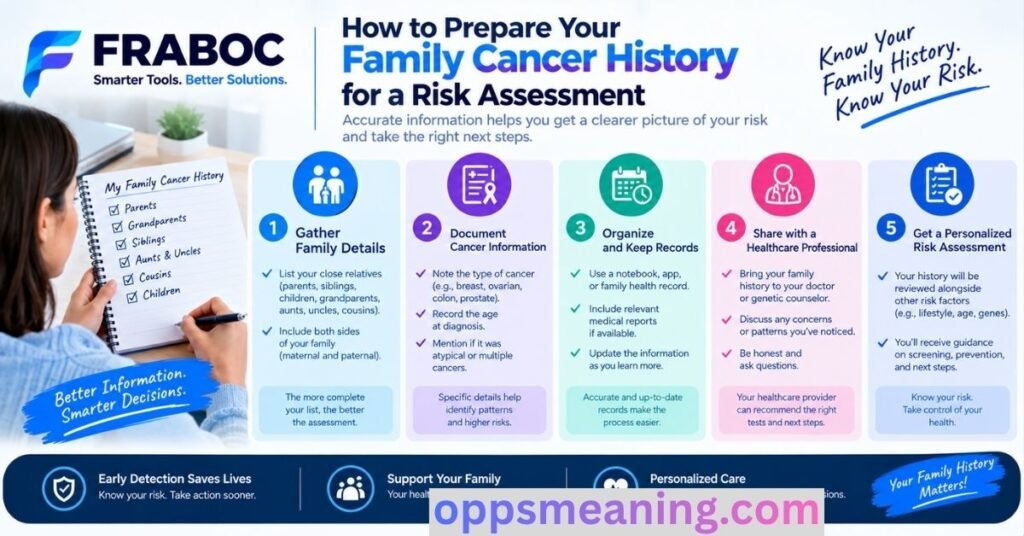
A little homework makes a big difference. Good family history documentation gives your doctor better data. Better data leads to a more accurate result. Start by talking with relatives. Ask about both sides of the family. Write down what you learn. If a relative has had a gene test, bring a copy of the result when you can. Don’t worry about missing details. Share what you know and say what feels uncertain.
Use the checklist below as a guide. Each row shows one item to collect. A clear record also helps with genetic testing eligibility checks later. It supports personalized cancer risk assessment too. Keep your notes in one place. Update them whenever news arrives.
| What to Collect | Why It Matters |
| Which relatives had cancer | Shows how closely related they are to you |
| The cancer type for each person | Separates breast and ovarian patterns from others |
| Age at diagnosis | Early diagnoses raise concern |
| Cancer in both breasts or more than one cancer | Can point to hereditary cancer predisposition |
| Breast cancer in a male relative | A recognized high-risk feature |
| Genetic test results | Confirm or rule out known gene changes |
Frequently Asked Questions
What Does FRABOC Stand For?
FRABOC stands for Familial Risk Assessment – Breast and Ovarian Cancer. People also write it as FRA-BOC. Cancer Australia published it for health professionals. It sorted family history into broad risk groups.
What Was FRABOC Used For?
Doctors used it to read a patient’s family history. It helped them pick a risk group and decide on referrals. It also helped them explain results. It did not diagnose anything.
Is FRABOC Still Available?
No. Cancer Australia has removed it from its website. Newer tools such as iPrevent now fill that role. Old documents may still mention the name.
Was FRABOC a Genetic Test?
No. It reviewed family history only. Genetic tests analyze DNA from blood or saliva. A FRABOC result could lead a doctor to suggest one.
Can FRABOC Diagnose Breast or Ovarian Cancer?
No. It could not find or diagnose cancer. It only estimated family-related risk. Diagnosis needs medical tests and a doctor’s review.
What Replaced FRABOC?
Cancer Australia points to iPrevent. CanRisk and IBIS are other current models. All three give more personal estimates than the old tool.
What Is the Difference Between FRABOC and iPrevent?
The old tool sorted women into three broad groups using family history. iPrevent adds personal and lifestyle factors. It gives a tailored estimate and a current risk category. Only iPrevent is in use today.
Does a Family History of Breast Cancer Mean You Are at High Risk?
Not always. Risk depends on how many relatives were affected and how close they are. Cancer type and age at diagnosis matter too. A doctor can weigh all these factors for you.
Can You Use iPrevent Without a Doctor?
Cancer Australia describes iPrevent as a tool to support talks between women and doctors. A health professional can explain the result best. It isn’t meant for people who’ve had invasive breast cancer or DCIS.
Does Breast Cancer on Your Father’s Side Matter?
Yes. Gene changes linked to breast and ovarian cancer can pass through either parent. Always include both sides of the family in your history.
What Is the FRA-BOC Flight Route?
It’s a travel code for Frankfurt (FRA) to Bocas del Toro in Panama (BOC). It has no link to the cancer risk tool.
When Should You See a Doctor About Your Family History of Cancer?
See a doctor whenever your family history worries you. A GP is a good first stop. They can review your history and refer you to a family cancer clinic or genetics service if needed.
Final Thoughts
Here’s the big picture. FRABOC turned family history into a broad risk group. It was never a cancer test or a genetic test. Today it’s retired. Its story still teaches a useful lesson. Family patterns matter, and clear records help doctors guide your care.
Your next step is simple. Gather your family details and book a talk with your GP. Ask about iPrevent, CanRisk or IBIS. Newer tools offer a sharper view of inherited breast and ovarian cancer risk than the old three-group method ever did.
Medical disclaimer: This article offers general information and not medical advice. Historical FRABOC figures appear only to explain how the retired tool worked. Speak with a qualified health professional about your own family history and risk.

Ethan Brooks is a language writer who shares simple explanations of word meanings, grammar, phrases, slang, and everyday expressions. His goal is to make confusing language easy to understand with clear and helpful information.






One Comment