GrammarVista.com USA: Complete Guide to English Grammar, Features & Review (2026)
Do you want clearer English? You’re not alone. Millions of people search for a trusted English grammar guide every month. This article explains what GrammarVista.com USA is, what it offers, and where it falls short. You’ll also learn core English grammar rules with simple grammar examples. We cover American English grammar, punctuation, vocabulary, and editing. Think of this page as a friendly map. It shows the main roads of English. Then it helps you decide whether this grammar learning website fits your goals.
What Is GrammarVista.com USA?
GrammarVista.com USA is an English writing resource. It focuses on grammar, punctuation, vocabulary, and sentence building. People often search for it because they want fast answers. Is this sentence correct? Which word fits here? A good site gives a rule, an example, and a reason.
The “USA” part points to American English. It doesn’t mean a separate website. One outside review says the name refers to GrammarVista.com and its American English tools, not a separate U.S. site. Keep that in mind as you read. Every section below answers the question what is GrammarVista.com USA in plain words.
GrammarVista.com USA: Key Features and Overview
The GrammarVista.com features most readers care about fall into a few groups. The table below gives a quick view. It also shows why each area matters for online grammar resources.
| Topic | What You May Find | Why It Matters |
| English grammar | Verbs, nouns, pronouns, and agreement | Builds accurate sentences |
| Punctuation | Commas, apostrophes, colons, and semicolons | Prevents confusing meanings |
| Vocabulary | Word choice and context | Improves precision |
| Sentence structure | Fragments, run-ons, and clauses | Makes writing easy to read |
| American English | U.S. spelling and style | Helps you write for U.S. readers |
| Professional writing | Emails and reports | Creates a polished impression |
Think of the site as a reference shelf. You pull down one book when you need it. You don’t read the whole library in a day. That habit supports steady vocabulary improvement and calmer English language learning.
Why English Grammar Matters in Everyday Communication
Grammar is the glue of written language. Without it, words pile up like loose bricks. With it, ideas form a wall that stands. Every email, essay, and text message depends on this glue. Readers notice errors fast. They also forgive them slowly.
Good grammar saves time. You explain once instead of twice. Your reader gets your point right away. That matters at school, at work, and online. Strong English writing tips always start with clear grammar.
How Grammar Improves Clarity
Clear grammar removes guesswork. Read this line: The manager told the employee he needed to improve. Who needs to improve? A clearer version says: The manager told the employee, “You need to improve your report.” Now nobody has to guess.
Why Grammar Matters in Professional Writing
Readers judge you by your writing. A message full of errors can look careless. Here is a flawed line: Your package has been shiped and should of arrived yesterday. The fixed line reads: Your package has shipped and should have arrived yesterday. Small fixes build trust and sharpen professional writing skills.
How Grammar Helps Preserve Meaning
Word order changes meaning. Compare Only Sarah finished the report with Sarah finished only the report. The first says nobody else finished it. The second says she finished nothing else. Tiny shifts create big differences. Careful grammar protects what you truly mean.
Understanding American English
English changes from country to country. Spelling, vocabulary, and punctuation all shift a little. The core grammar stays the same. If you write for readers in the United States, you should follow American English grammar and American spelling rules. Consistency matters most.
Neither style is better. Each one fits a different audience. A U.S. company should use American forms. A London firm should use British forms. Mixing both in one document looks messy.
American English vs. British English
The two styles share one grammar system. They differ in spelling and everyday words. Here is a quick comparison for the difference between American and British English.
| American English | British English |
| color | colour |
| center | centre |
| favorite | favourite |
| traveling | travelling |
| apartment | flat |
| elevator | lift |
| vacation | holiday |
| sidewalk | pavement |
American English Examples
Here are two American sentences. Our organization opened a new learning center downtown. And: We took a vacation and rode the elevator to the top. Notice the “z” in organization and the “er” ending in center.
British English Examples
Now look at the British versions. Our organisation opened a new learning centre in the city centre. And: We went on holiday and took the lift to the top. The style changes. The grammar stays steady.
American English Spelling and Punctuation Rules
Common American English grammar rules include “or” in color and “ize” in organize. Periods and commas go inside closing quotation marks. For example: She called the plan “promising.” These habits make your writing feel natural to U.S. readers.
English Grammar Fundamentals
Every sentence uses a small set of building blocks. Learn them once and complex writing gets easier. This section is ideal for grammar learning for beginners. It covers nouns and pronouns, verbs, and modifiers.
Don’t try to memorize everything at once. Pick one block per day. Write three sentences using it. Small steps beat long study nights every time.
Types of Nouns and Their Uses
A noun names a person, place, thing, or idea. Examples include teacher, Chicago, laptop, and freedom. Nouns act as subjects and objects in sentences. Spotting them helps you test whether a sentence is complete.
Common Nouns and Proper Nouns
Common nouns name general things such as city or company. Proper nouns name specific ones such as Boston or Microsoft. Proper nouns start with capital letters. That small rule signals importance to the reader.
Singular and Plural Nouns
Singular means one. Plural means more than one. Most plurals add -s or -es. Irregular plurals break the pattern, as in child and children, mouse and mice, or foot and feet. Learn these by heart.
Understanding Verbs and Tenses
Verbs show action, state, or change. Think of write, seem, and become. They also show time. English verb tenses tell readers when something happens. Choose a tense and keep it steady unless time truly changes.
Present, Past, and Future Tenses
Present: She works in Boston. Past: She worked in Boston. Future: She will work in Boston. Perfect forms add detail, as in She has worked there for five years. Each form answers the question “when?”
Adjectives and Adverbs
Adjectives describe nouns. Adverbs describe verbs, adjectives, or other adverbs. Compare a detailed proposal with she answered quickly. Many adverbs end in -ly. Not all do. Judge a word by its job in the sentence.
Subject-Verb Agreement
Subject-verb agreement means a singular subject takes a singular verb. The student writes daily. A plural subject takes a plural verb. The students write daily. Watch for extra words in between. In The quality of these products has improved, the subject is quality.
Pronouns and Clear References
Pronouns replace nouns. They stop repetition. But every pronoun needs a clear target. Consider When Sarah talked to Emily, she was upset. Who was upset? Rewrite it: Sarah was upset when she talked to Emily. Now the reference is clear.
Sentence Structure and Grammar Rules
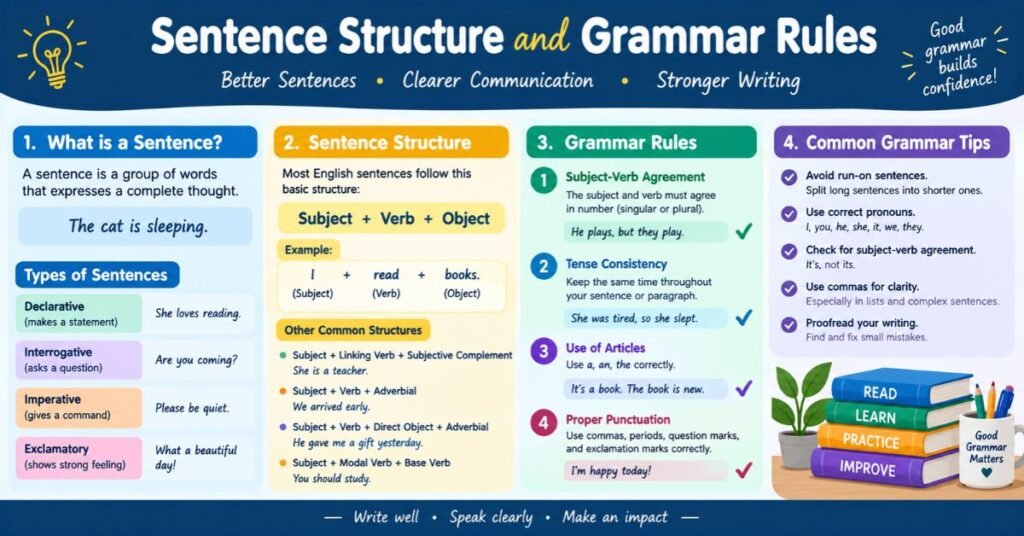
Good sentence structure is like a well-built bridge. Each part supports the next. If one piece is missing, readers stumble. Strong structure also makes your English writing tips easier to apply.
Most writing problems come from three issues. Fragments leave thoughts unfinished. Run-ons mash thoughts together. Long chains of clauses lose the reader. The sections below show how to fix each one with grammar examples.
What Makes a Complete Sentence?
A complete sentence has a subject and a predicate. It also expresses a full thought. The conference begins tomorrow. The subject is “the conference.” The predicate is “begins tomorrow.” Nothing is left hanging.
Sentence Fragments and How to Fix Them
Sentence fragments look like sentences but feel unfinished. Although the results were encouraging. The reader waits for more. Add the missing piece: Although the results were encouraging, the team ordered more tests. Fragments can work in ads. Avoid them in formal writing.
Run-On Sentences and Correct Punctuation
Run-on sentences join complete thoughts without proper punctuation. A common type is the comma splice: The deadline is Friday, we must finish today. You can fix it in three ways. The next three headings show each method.
Fixing Run-On Sentences With Periods
The easiest fix is a period. The deadline is Friday. We must finish today. Short sentences are clear and strong. Use this method when the two ideas feel separate.
Using Semicolons Correctly
A semicolon links two closely related complete thoughts. The deadline is Friday; we must finish today. Each side must stand alone. Use semicolons sparingly so they keep their impact.
Connecting Ideas With Conjunctions
A conjunction builds a bridge between ideas. The deadline is Friday, so we must finish today. Common choices are and, but, or, so, and yet. Pick the word that shows the real relationship.
Read More About: AllysPlay.com Explained: Features, Game Guides, and Safety Review (2026)
English Punctuation Rules Explained
Punctuation is traffic control for sentences. It tells readers when to pause, stop, or turn. This punctuation guide covers the marks that cause the most trouble. Learn how to use punctuation correctly and your writing will flow.
A single mark can change meaning. Take Let’s eat, Grandma and Let’s eat Grandma. One comma saves a life. That joke is old. The lesson is still true.
How to Use Commas Correctly
Commas cause more doubt than any other mark. These comma usage rules cover the three most common jobs. Read each example and notice where the comma sits.
Commas in Lists
Use commas to separate items in a list. We bought notebooks, pens, folders, and markers. The final comma is the Oxford comma. It prevents mix-ups, such as thanking your parents, Taylor Swift, and Abraham Lincoln.
Commas After Introductory Phrases
Place a comma after an opening phrase. After the meeting, we returned to the office. The comma gives the reader a short pause. It marks where the main sentence begins.
Commas Between Independent Clauses
Join two complete thoughts with a comma plus a conjunction. The rain stopped, but the road stayed wet. Both sides could stand alone. The comma and conjunction work as a team.
Apostrophes: Possession and Contractions
Apostrophe rules have two main jobs. They show ownership and they mark missing letters. Keep these two jobs in mind. Most mistakes happen when writers mix them up.
Singular and Plural Possessives
For one owner add ‘s. The student’s notebook. For a regular plural owner add only the apostrophe. The students’ notebooks. The position of the mark tells readers how many owners there are.
Apostrophes in Contractions
A contraction joins two words. The apostrophe marks the missing letters. Don’t means do not. They’re means they are. You’re means you are. Contractions make writing sound friendly.
It’s vs. Its: Meaning and Usage
It’s means it is or it has. Its shows ownership. It’s going to rain. The company changed its policy. Here is a trick. Replace the word with “it is.” If the sentence still works, use it’s.
Semicolons and Colons: Rules and Examples
A semicolon joins two related complete thoughts. It also separates complex list items, as in Austin, Texas; Portland, Oregon; and Miami, Florida. A colon introduces an explanation or list. She packed three things: a notebook, a charger, and her passport. Words before a colon should form a full thought.
Possessives and Compound Words
Two topics trip up many writers. One is possessive nouns. The other is compound words in English. Both depend on small details. Once you see the pattern, you won’t forget it.
Think of possessives as name tags. They show who owns what. Think of compounds as teamwork. Two words join to make one idea. The next sections explain both clearly.
Singular, Plural, and Irregular Possessives
Singular nouns add ‘s, as in James’s computer. Regular plurals add only an apostrophe, as in the employees’ benefits. Irregular plurals add ‘s, as in children’s books and women’s clothing. Check the plural form first. Then add the mark.
Possessive Pronouns and Their Uses
Possessive pronouns never use apostrophes. The list is mine, yours, his, hers, ours, theirs, and its. Correct: The final decision is theirs. Incorrect: The final decision is their’s. This is one of the grammar mistakes to avoid.
Types of Compound Words
English builds compounds in three ways. They can be closed, hyphenated, or open. Spelling can change over time. A hyphenated word from 1990 may now be one word. Check a current dictionary when unsure.
Closed Compound Words
Closed compounds are written as one word. Examples include website, notebook, keyboard, and classroom. Many tech terms follow this path over time.
Hyphenated Compound Words
Hyphenated compounds use a hyphen. Examples include well-known, long-term, and up-to-date. Use a hyphen before a noun: a full-time job. Skip it after the verb: she works full time.
Open Compound Words
Open compounds stay as two words. Examples include post office, high school, and living room. They act as one idea but keep a space between the parts.
Vocabulary and Commonly Confused Words
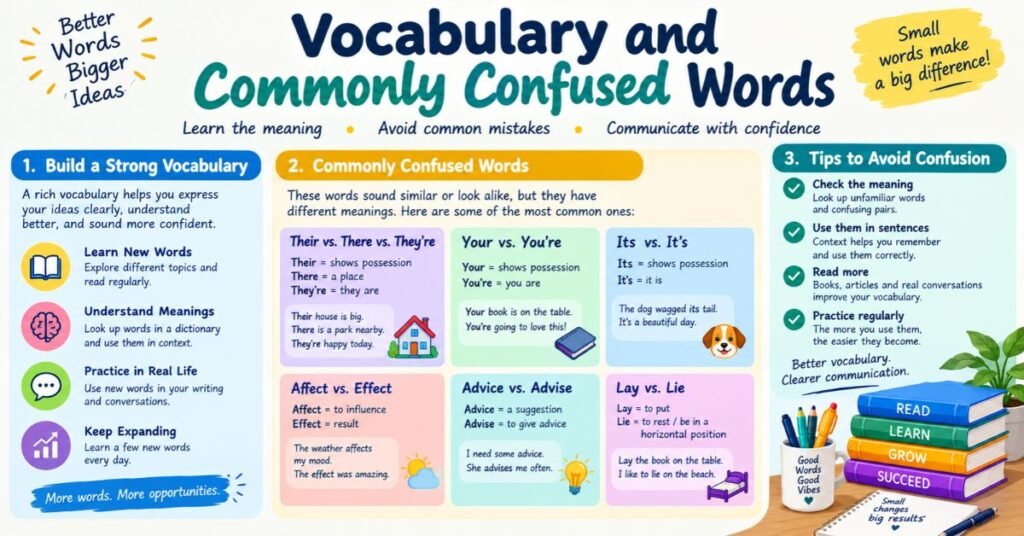
Strong vocabulary doesn’t mean big words. It means the right word. Plain words often work best. This section supports vocabulary improvement and explains commonly confused words that appear in everyday writing.
Many pairs sound alike. Others have close meanings. Learn them through context. Short example sentences stick in memory far better than dictionary lists.
How Context Changes Word Meaning
Words with similar meanings aren’t always equal. Inexpensive sounds neutral or positive. Cheap may suggest poor quality. A hotel described as inexpensive sounds like a smart choice. A cheap hotel sounds risky. Context decides.
Their vs. There vs. They’re
They shows ownership: Their house is nearby. There points to a place or an idea: Put the box there. They mean they are: They’re arriving tomorrow. Test by saying “they are.” If it fits, use they’re.
Your vs. You’re
Your shows ownership: Your appointment is confirmed. You’re means you are: You’re scheduled for Monday. Use the same test. Say “you are” in place of the word. If the sentence still works, choose you’re.
Read More About: Simple Health Check Methods: 15 Easy Ways to Monitor Your Health at Home
Affect vs. Effect
Affect is usually a verb. The weather affected our plans. Effect is usually a noun. The new rule had a strong effect. Exceptions exist. This simple rule solves most daily cases.
Then vs. Than
Then talks about time or order. Finish the report, then email it. Than compares. This option is cheaper than the last one. If you compare two things, use than.
Compliment vs. Complement
A compliment is praise. She complimented his talk. A complement completes something. The sauce complements the meal. Here is a memory trick. Complement has “complete” in it.
Advice vs. Advise
Advice is a noun. She gave me good advice. Advise is a verb. I advise you to read the contract. The noun ends with a soft “s” sound. The verb ends with a “z” sound.
Fewer vs. Less
Use fewer for things you can count. Fewer customers. Fewer mistakes. Use less for amounts you can’t count one by one. Less traffic. Less water. Everyday speech bends this rule. Formal writing keeps it.
Could Have vs. Could Of
The correct form is could have. Incorrect: I could of finished earlier. Correct: I could have finished earlier. The mistake comes from speech. The spoken contraction could’ve sounds like “could of.”
Formal vs. Informal English
The same idea can sound casual or serious. Formal and informal writing each have a place. Your audience and goal decide the choice. Ask yourself one question. Does this wording fit my reader?
Too much formality can sound cold. Too much slang can seem careless. Aim for the middle in most business settings. Keep it clear, polite, and direct.
Informal English Examples
Informal English sounds like talking. Hey, just checking if you got my email. It uses contractions and short phrases. Use it with friends and close coworkers.
Neutral and Professional English Examples
Neutral English works almost everywhere. Hi, I wanted to check whether you received my earlier email. It’s polite and easy to read. This style suits most workplace messages.
Formal English Examples
Formal English suits official letters and reports. I am following up to confirm whether you received my previous message. It avoids slang and uses complete forms. Keep it short even when it’s formal.
How to Choose the Right Tone for Your Audience
Start with who will read your words. A manager, a client, and a friend need different tones. Next, think about your goal. Are you asking, informing, or thanking? Match your wording to both and you’ll rarely miss.
How to Write Better Professional Emails
Professional email writing is a daily skill. Strong emails are clear, short, and kind. They respect the reader’s time. They also make the next step obvious.
Picture a busy reader on a phone. She gives your message ten seconds. Can she see the topic, the point, and the request? If so, you’ve done your job. These tips turn that idea into habit.
Write a Clear and Specific Subject Line
A weak subject says “Hello.” A strong one says “Updated Project Timeline – August 20.” The reader instantly knows the topic. Specific subjects also help people find your email later.
State Your Purpose Early
Put the reason for your email in the first lines. I’m writing to confirm the new delivery date for the August campaign. Readers shouldn’t hunt for the point. Lead with it.
Make Requests Clear and Actionable
Vague: Please let me know. Clear: Please confirm by Thursday whether the new schedule works for your team. A date and a question make replying easy. Easy replies come faster.
Use Natural and Professional Language
Skip stiff phrases like Kindly be advised that we are in receipt of your aforementioned correspondence. Write Thank you for your message. We received your request and are reviewing it. It’s shorter and warmer. It’s still professional.
Grammar Rules for Academic Writing
Academic English values precision over decoration. Complex ideas need simple sentences. Good academic writing grammar keeps arguments easy to follow. It also makes your work look serious and careful.
Avoid padding. Compare Due to the fact that many individuals demonstrated an inability to finish the survey with Because many participants did not finish the survey. The second version says the same thing in fewer words. Teachers love that.
Define Key Terms Clearly
Define any term that readers could read in two ways. Do it the first time you use it. Add a short example if needed. Clear definitions prevent confusion later in the paper.
Use Pronouns Consistently
Words like it, this, they, and which can confuse readers. Make sure each one points to one clear noun. If a reader must guess, repeat the noun instead. Clarity beats elegance.
Choose Appropriate Transition Words
Transition words show how ideas connect. Use them with purpose. Don’t sprinkle them into every sentence. The four groups below cover most needs.
Transition Words for Adding Information
Use furthermore, additionally, and moreover. They tell the reader that more support is coming. Additionally works well before a new supporting point.
Transition Words for Contrast
Use however, nevertheless, and in contrast. They warn the reader that the idea turns. However is the most common choice in essays.
Transition Words for Cause and Effect
Use therefore, consequently, and as a result. They link a reason to its outcome. Use them only when the cause is real.
Transition Words for Examples
Use for example, for instance, and specifically. They introduce proof. A good example makes an abstract point feel real.
How to Make Any Sentence Clearer
A messy sentence can be fixed in five steps. Think of it like tidying a desk. You sort, remove clutter, and put things back neatly. These English editing techniques work on emails, essays, and posts.
The steps follow a simple order. Start with the idea. End with your ears. Each step takes seconds once you practice. Soon it becomes automatic.
Step 1: Identify the Main Message
Ask what you want to say. Write it in one short sentence. If you can’t, the sentence is probably confusing. Fix the idea first. Fix the words second.
Step 2: Find the Subject and Verb
Look for who or what acts. Then find the action. In The rollout of several new workplace procedures designed to improve teamwork has caused delays, the core is “rollout has caused.” Seeing the core makes editing easier.
Step 3: Remove Unnecessary Words
Cut filler. At this point in time, we are currently reviewing the application becomes We are reviewing the application. Same meaning. Half the length.
Step 4: Replace Vague Expressions
Swap fuzzy words for specific ones. They did some things to improve the system becomes The developers simplified checkout and fixed several payment errors. Specific details help readers picture the facts.
Step 5: Read the Sentence Aloud
Your ear catches problems your eyes miss. Listen for awkward rhythm and repeated words. Notice missing words too. If you run out of breath, split the sentence.
Common English Grammar Mistakes to Avoid
Even skilled writers repeat the same errors. Knowing your weak spots is half the battle. This list of common grammar mistakes and grammar mistakes to avoid helps you proofread faster. It also supports how to proofread English writing with confidence.
Keep notes on your own slips. Most people repeat only five or six. Fix those and your writing improves quickly.
Misplaced Modifiers
A modifier should sit next to the word it describes. Walking through the parking lot, the rain soaked my jacket suggests the rain was walking. Fix it: While I was walking through the parking lot, the rain soaked my jacket.
Unnecessarily Long Sentences
Long sentences aren’t always wrong. They fail when too many ideas fight for space. Split them. Two clear sentences beat one tangled one. Your readers will thank you.
Inconsistent Verb Tenses
Don’t jump between past and present without a reason. Incorrect: She entered the room and looked at the screen. Correct: She entered the room and looked at the screen. Keep the time frame steady.
Common Punctuation and Pronoun Errors
Watch for its and it’s, missing commas after openers, and vague pronouns. These three slips cause most editing notes. Check each one during your final read. A short checklist works wonders.
GrammarVista.com Review 2026: Benefits and Limitations
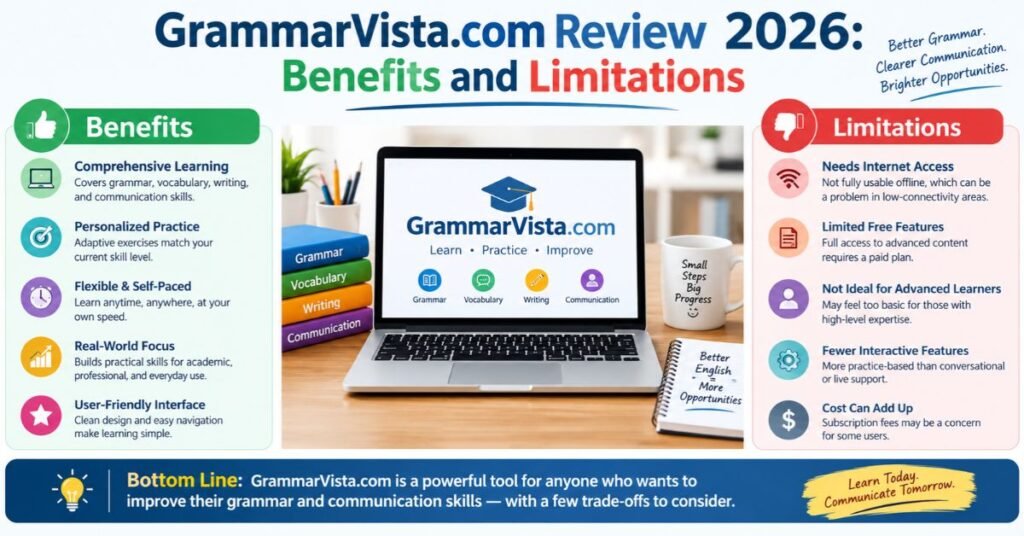
This GrammarVista website review looks at the site fairly. We’ll cover what it offers, what’s unclear, and how to judge any grammar source. The GrammarVista.com review 2026 below is based on public information and outside write-ups. Details can change.
Please note one point. Outside sources don’t all agree. One review describes a grammar checker with spelling support and readability tools. Another describes a site that mainly publishes guides and also carries news and other topics on its homepage. Always visit the site yourself before you decide.
What Can You Find on GrammarVista.com?
Visitors usually look for guides on grammar, words, and punctuation. Some reports also mention writing tools. Your experience may differ. The sections below describe the main areas.
Grammar and Vocabulary Resources
Expect explanations of verbs, nouns, agreement, and word choice. These pages support English language learning and grammar practice exercises when the site provides them. Check whether each page includes examples.
Punctuation and Sentence Structure Guides
Look for pages on commas, apostrophes, fragments, and run-ons. Good guides show right and wrong versions side by side. That format helps memory far more than abstract rules.
Read More About: Why Does Ozdikenosis Kill You? The Truth Behind This Mysterious Disease (2026 Guide)
Does GrammarVista.com Cover Topics Beyond Grammar?
Possibly. One outside source says the homepage carries news, entertainment, and health stories next to its language content. That mix can make the site feel broad. If you want pure grammar help, use the grammar sections and skip the rest.
Pros and Cons of GrammarVista.com
Here is a balanced view of GrammarVista.com benefits and limitations. Treat it as a starting point. Confirm each item on the live site.
| Possible Pros | Possible Cons |
| Focus on American English | Reports about features differ |
| Plain, practical explanations | Content may mix grammar with other topics |
| Covers punctuation, possessives, and compounds | Not a replacement for a teacher or editor |
| Easy to scan for quick answers | Quality varies by page and author |
Is GrammarVista.com a Grammar Checker Like Grammarly?
It depends on whom you ask. One outside review says the site offers a grammar checker with spelling support. Other write-ups describe only articles. Test the live site. Paste a short paragraph and see what happens. Don’t assume it matches full commercial tools.
Is GrammarVista.com Free to Use?
One third-party review says the core checker is free and needs no account. That claim comes from an outside source. Check the site for its current terms. Free access can change. Never pay or share personal data before reading the page carefully.
What to Check Before Trusting a Grammar Article
Look for clear examples and accurate rules. Check that advice matches a trusted style guide. See whether the page lists an author and a date. A good article explains why a rule works. It doesn’t just announce it.
GrammarVista.com vs. Grammervista.com
Many people mistype website names. A single changed letter can lead to a different place. That’s why this comparison matters. It protects your time and your data. It also supports smart how to evaluate online grammar resources habits.
Our search found no clear proof of a separate Grammervista.com grammar site. That doesn’t prove none exists. It means you should check the spelling yourself. Type the address carefully. Don’t rely on search ads or random links.
Understanding the Difference Between the Two Domains
The two names differ by one letter. “Grammar” has an “a.” “Grammer” has an “e.” Different spellings can mean different owners. Treat the pair as separate until you’ve verified otherwise.
Why the Exact Website Address Matters
Wrong addresses can lead to copycat pages. Those pages may show ads or ask for personal details. Exact spelling protects you. Bookmark the correct address once you’ve confirmed it.
How to Verify You Are Using the Correct Website
Type the address by hand. Look for the padlock icon in your browser. Read the About page and the contact details. Never enter passwords or payment details on a site you don’t trust.
What Does GrammarVista.com USA Mean?
The phrase “GrammarVista.com USA” confuses some readers. Does it mean a special U.S. edition? Or does it just describe an audience? Clear answers help you search smarter. They also help you judge what you read.
In most cases, “USA” shows a focus on American readers. It signals American spelling and style. It doesn’t prove a separate website. Use it as a hint, not a guarantee.
Is There a Separate USA Version?
One outside review says no separate U.S.-only version exists. It says American English is the default and British spelling is also recognized. Confirm this on the live site if the detail matters to you.
What American English Resources Are Available?
Look for guidance on U.S. spelling, comma habits, and quotation marks. Also look for word lists with American forms. These pages help you meet the American spelling rules your readers expect.
How to Interpret the USA Search Term
Treat “USA” as a search label. It tells engines you want American English results. It works like adding a city name to a restaurant search. It narrows the field. It doesn’t create a new place.
How to Evaluate GrammarVista.com Articles
You should test every online source. This habit protects you from bad advice. It also builds skill. Strong readers question what they read. Use the four checks below on any online English learning resources.
None of these checks takes long. Together they paint a clear picture. A page that passes all four deserves more trust.
Check the Author and Publication Date
Find out who wrote the page and when. Grammar rules change slowly. Still, old advice can be outdated. A named author adds accountability.
Compare Examples With Explanations
Good examples match the rule. If the example contradicts the rule, something is wrong. Read both slowly. Make sure the “wrong” and “right” versions truly differ.
Distinguish Grammar Rules From Style Preferences
Some advice is fixed grammar. Other advice is style. The Oxford comma is a good case. Many guides prefer it. Some publications skip it. Know which type you’re reading.
Verify Important Information With Reliable Sources
Confirm key rules in a trusted dictionary or style guide. Do this before an exam, a job application, or a publication. Two sources are better than one. It takes a minute.
A Practical English Editing Checklist
A strong English proofreading checklist works in layers. You don’t catch everything in one pass. Instead, you check one thing at a time. This saves energy. It also catches more errors.
Print the checklist or keep it on your desk. Use it for every important document. Over time you’ll internalize the steps. Then editing feels like second nature.
Review Meaning and Clarity
Ask whether the main idea is clear. Look for missing facts. Check that each paragraph has a job. If a line confuses you, it will confuse readers.
Check Sentence Structure
Look at paragraph order and flow. Remove repeated ideas. Check that transitions make sense. Break up long sentences that tire the reader.
Correct Grammar and Verb Tenses
Check agreement, tense, pronouns, fragments, and run-ons. Read slowly. Point to each verb. Make sure it matches its subject and time frame.
Review Punctuation
Scan commas, apostrophes, colons, and quotation marks. Look at every its and it’s. Confirm that periods and commas sit inside quotation marks in American English.
Improve Vocabulary and Word Choice
Hunt for vague words like “thing” and “stuff.” Replace them with exact terms. Cut fancy words that don’t help. Choose words your audience knows.
Proofread the Final Draft
Look for typos, missing words, and spacing slips. Check capitalization and spelling consistency. Read the text aloud one last time. Better still, wait an hour first.
How to Improve English Grammar Over Time
You don’t need to learn everything today. Real progress comes from small, steady habits. Here is how to improve English grammar without stress. These habits work for students, workers, and writers alike.
Think of grammar like fitness. One long session won’t make you strong. Short daily practice will. Ten minutes a day beats two hours once a month.
Read High-Quality English Content Regularly
Read news, books, and well-edited articles. Notice how writers open paragraphs and link ideas. Your brain absorbs patterns without effort. Over time, correct forms start to feel natural.
Keep a Personal Grammar Mistake List
Write down every error you find in your own work. Review the list weekly. Most people repeat the same few slips. Targeting them saves hours of study.
Practice Rewriting Sentences
Take a wordy sentence and cut it down. We made the decision to postpone the meeting because of the fact that several people were unavailable. We postponed the meeting because several people were unavailable. Do one rewrite daily.
Learn Vocabulary in Context
Learn words in phrases. Don’t study “decision” alone. Learn to make a decision, reach a decision, and make a final decision. Phrases show how words live together in real English.
Use Grammar Exercises and Quizzes
Test yourself often. Grammar practice exercises show what you really know. Quizzes also make learning more fun. Even a five-question check helps you spot weak areas.
Who Can Benefit From GrammarVista.com?
A grammar resource helps many kinds of readers. The key is matching the content to your goal. Below are four groups who may find it useful. Each group has different needs. That’s why plain examples matter.
The common thread is communication. Everyone wants to be understood. Better grammar clears the path between your idea and your reader. It’s a skill worth building at any age.
Students
Students write essays, reports, and exam answers. They need clear English grammar for students and professionals alike. Learning the “why” behind a rule beats copying a correction. It lasts longer.
English Language Learners
Learners often struggle with articles, prepositions, and verb tenses. They also face idioms and phrasal verbs. Short examples help a lot. Start with grammar learning for beginners topics and build up.
Professionals
Professionals write emails, proposals, and reports. A few clear fixes can raise your credibility. It’s an easy way to improve professional communication skills. Clean writing saves meetings too.
Writers and Content Creators
Writers face questions about punctuation, word choice, and flow. Grammar should support your voice. It shouldn’t flatten it. Use the rules as a toolbox, not a cage.
FAQ,s
What Is GrammarVista.com USA?
GrammarVista.com USA is an English grammar and writing resource. It covers grammar, vocabulary, punctuation, and sentence structure with an American English focus. It is generally described as GrammarVista.com itself, not a separate U.S.-only site.
Is GrammarVista.com Useful for Learning American English?
Yes, it can be. The site focuses on American spelling, punctuation, and word choice. Use it alongside a trusted dictionary. That way you can confirm each rule and build steady confidence with U.S. conventions.
Can Beginners Use GrammarVista.com?
Yes. Beginners can start with nouns, verbs, and punctuation. Then they can move to commonly confused words. Short examples help new learners. Go slowly and practice each topic before moving to the next one.
Is GrammarVista.com Helpful for Students?
Yes. Students can use it to understand punctuation, agreement, and word choice. It works best as a supplement. Follow your teacher’s style guide for assignments. Always double-check important rules before you submit work.
Is GrammarVista.com the Same as Grammervista.com?
Not necessarily. The two names differ by one letter, and we found no clear proof of a separate Grammervista.com grammar site. Type the address carefully. Check the About page and padlock icon before using any site.
Should GrammarVista.com Replace a Teacher or Professional Editor?
No. Online guides help you learn and check quickly. They can’t replace personal feedback. A teacher or editor understands your goals and context. Use the site as a helper for daily questions and routine edits.
How Can I Tell if a Sentence Is Grammatically Correct?
Find the subject and verb first. Then check agreement, tense, and completeness. Look at punctuation, pronouns, and modifiers. Finally read the sentence aloud. If it sounds odd, revise it and test again.
Why Can a Grammatically Correct Sentence Sound Unnatural?
Grammar is only one part of natural English. Word choice, tone, and common phrases matter too. A sentence can follow every rule and still feel stiff. Read natural English often to hear the difference.
What Is the Difference Between Grammar and Punctuation?
Grammar governs how words and clauses fit together. Punctuation uses marks like commas and periods to show that structure. Grammar builds the sentence. Punctuation signals where ideas start, pause, and end for the reader.
What Is the Best Way to Improve English Grammar?
Read often, write daily, and review your own mistakes. Use short quizzes and proofread in layers. Learn words in phrases. Steady practice works better than cramming. Small habits add up over weeks.
conclusion
For most learners, the answer is a cautious yes. The site targets a useful topic and uses an American English focus. Plain explanations and practical examples are real strengths. These make it a handy grammar learning website for quick questions. Still, reports about its tools and content vary.
So test it yourself. Check the spelling of the address. Try a few articles. Compare rules with a trusted guide. Use it as a helper and not as the final judge. Do that and you’ll get the most from this English grammar guide and the GrammarVista.com review 2026 you just read. For more detail on one outside description of the site, see this third-party overview.

Ethan Brooks is a language writer who shares simple explanations of word meanings, grammar, phrases, slang, and everyday expressions. His goal is to make confusing language easy to understand with clear and helpful information.