70+ 1437 Meaning in Text: Amazing Guide to 1437 in Chat & Slang
You open your phone. A message pops up. It just says 1437. No words. No explanation. Just four numbers sitting there on your screen.
So, what does 1437 mean? You’re not alone in asking. Thousands of people search for this every month. It turns out those four digits carry a big message. Let’s break it down, piece by piece.
1437 Meaning in Text – Quick Meaning
Here’s the short answer. The 1437 meaning in text is “I love you forever.” That’s it. Four numbers, four words, one deep feeling packed into a tiny code.
This isn’t some random guess. It’s an actual numeronym, a word or phrase built from numbers instead of letters. People use it in texts, DMs, and comments to say something big without spelling it out. It feels private. It feels personal. And once you know the trick, you’ll spot it everywhere.
What Does 1437 Mean?
So what does 1437 mean in a text message, exactly? Each digit stands for the number of letters in a word. Put them together, and you get a full sentence hiding inside a short number.
It’s a bit like a secret handshake, but for texting. Someone sends it, and if you know the code, your heart skips a beat. If you don’t, you’re left scratching your head until a friend explains it or you search it online, just like you’re doing right now.
What Does Each Number in 1437 Represent?
This is where the magic happens. 1437 means I love you forever, and here’s exactly how that breaks down.
| Number | Letters | Word |
| 1 | 1 letter | I |
| 4 | 4 letters | Love |
| 3 | 3 letters | You |
| 7 | 7 letters | Forever |
So 1 means I, 4 means love, 3 means you, and 7 means forever. Line them up, and you get “I love you forever.” Simple, right? Once you see the pattern, it’s almost impossible to unsee.
1437 Meaning in Simple Words
Let’s keep this easy. In plain English, 1437 meaning in slang is just a shortcut. It’s a fast way to say “I love you forever” without typing the whole thing out.
Think about it like a nickname for a feeling. Instead of writing three whole words plus “forever,” someone types four digits. It saves time. It also adds a little mystery. And honestly, mystery is part of the fun in texting culture.
Why Does 1437 Mean “I Love You Forever”?
Here’s the deeper question. Why did people land on these exact numbers? The answer connects to English word lengths. Each digit in the code matches the letter count of a specific word, and that pattern isn’t random at all.
This kind of coded message works because English speakers can decode it instantly once they know the rule. It’s not based on sound, like some other language-based codes. It’s based purely on counting letters, which makes it a clean and logical system, even if it looks confusing at first glance.
The Meaning Behind 1, 4, 3, and 7
Let’s slow down and look at each piece. The number 1 stands for “I,” a single letter, a single number. The number 4 stands for “love,” which has four letters. The number 3 stands for “you,” a three-letter word. And the number 7 stands for “forever,” a word with exactly seven letters.
Put together, you get one of the most romantic phrases out there, hidden in plain sight. It’s clever. It’s compact. And it’s become one of the most recognized numeric love codes in modern texting slang.
How 1437 Became a Love Code
Numbers becoming symbols of love isn’t new. Long before smartphones, people found creative ways to express affection through shorthand. 1437 just happens to be one of the newer entries in that long tradition.
The idea caught on because texting rewards short messages. Nobody wants to type a full sentence every single time they want to express love. So a love code like this fills a gap. It’s fast, it’s cute, and it gives the sender a chance to be a little sneaky about their feelings.
Origin and Background of 1437
Where did this all start? There’s no single inventor credited with creating 1437. Instead, it grew out of an older, simpler code that had already been around for decades.
That older code is 143, meaning “I love you.” The number 1437 builds on it by tacking on “forever,” making the message feel more permanent. Interestingly, the roots of 143 go back further than texting itself, all the way to a lighthouse in Massachusetts called Minots Ledge Light. In 1894, this lighthouse flashed a one-four-three pattern, and locals nicknamed it the “I Love You Light.” That story shows just how far back this number pattern actually goes.
From 143 to 1437
So how did 143 turn into 1437? Someone, somewhere, decided that “I love you” needed an upgrade. Adding the number 7 for “forever” gave the phrase more weight and more commitment.
This progression makes sense once you think about how language evolves. People love adding intensity to feelings. “I love you” becomes “I love you so much.” “I love you forever” takes that even further. The number code simply followed the same emotional upgrade, just using digits instead of extra words.
How Social Media Popularized 1437
Social media platforms gave this old-school number code a fresh audience. 1437 meaning on TikTok videos, Instagram captions, and comment sections helped the term spread far beyond its original texting roots.
A mysterious number under a couple’s photo makes people curious. They comment, asking what it means. That curiosity drives engagement, and engagement drives visibility. Before long, 1437 became a recognizable piece of social media slang, appearing in captions, story replies, and relationship-themed content across nearly every platform.
1437 Meaning in Real-Life Conversations
Numbers on a screen only mean so much until you see them in action. Real conversations show how flexible this code really is, shifting in tone depending on who’s texting and why.
Below are a few everyday examples showing exactly how 1437 in text messages plays out between different kinds of relationships, from romantic partners to close friends.
1437 in WhatsApp Messages
Picture two partners living in different cities. One lands safely after a flight and texts the other. After a short back-and-forth, one types, “Only six more weeks until I’m home. 1437.” The other replies, “1437 too. Call me when you land.”
This is a classic example of 1437 in WhatsApp conversations. It works as reassurance, a way of saying the distance is temporary, but the feelings definitely aren’t.
Read More About: 7+ IMK Meaning Slang: Easy & Helpful Guide to IMK in Text, TikTok & Chat
1437 in Instagram DMs
Now picture two close friends. One is feeling insecure about a photo she almost deleted. Her friend reassures her, and she replies, “You always know what to say.” The friend responds, “That’s what I’m here for. 1437, bestie.”
This shows 1437 in Instagram DMs used in a totally platonic way. The word “bestie” makes the tone crystal clear, so there’s zero romantic confusion here.
1437 in TikTok Comments
On TikTok, couples often post “our story” style videos. Under one video showing a couple who broke up and later found their way back together, a commenter writes, “So this is what 1437 looks like?” The creator replies, “Through every version of us. Always.”
This kind of exchange shows how 1437 meaning in chat stretches beyond private messages into public comment sections, where strangers use it to describe a story they’re watching unfold.
1437 in Text Messages After an Argument
Not every use of 1437 comes wrapped in sweetness. Sometimes it shows up right after a tough conversation. One person texts, “I understand. I’m sorry for what I said. 1437.” The other replies, “I care about you too, but let’s talk properly tomorrow.”
This matters because it shows the code’s limits. 1437 in relationship conversations can soften a hard moment, but it doesn’t replace an honest apology or a real conversation. The feeling behind the numbers still needs actions to back it up.
1437 Meaning in Different Contexts
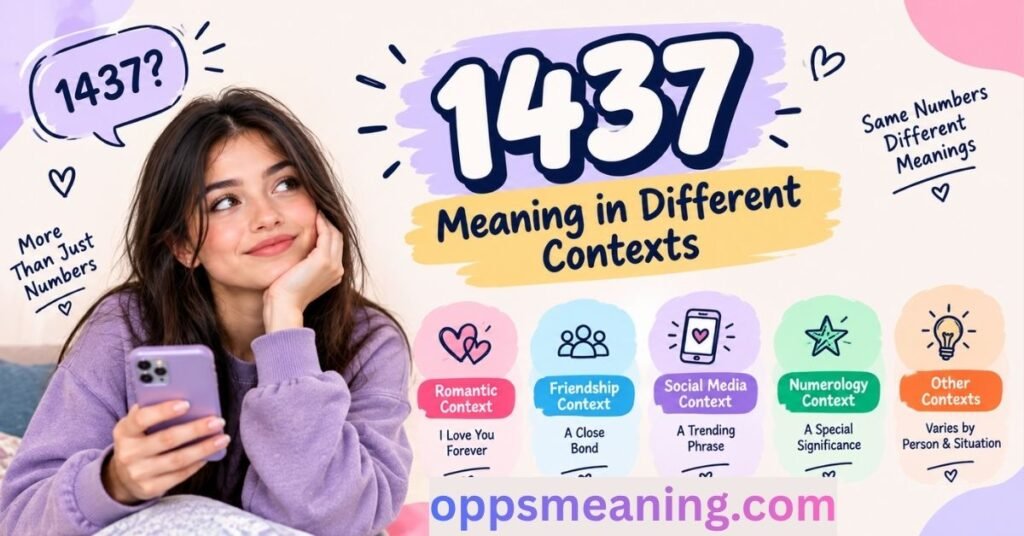
Context changes everything with this code. The same four digits can feel romantic, friendly, playful, or deeply sincere, all depending on where and how they’re used.
Understanding this 1437 emotional meaning shift helps you avoid awkward misreadings, whether you’re the one sending it or the one trying to figure out what it means.
1437 on Social Media
On public platforms, 1437 often shows up in captions, comments, and story replies. A heart emoji usually pushes the tone toward romance, while a laughing emoji can flip it into something playful or ironic.
Public posts carry more weight than private texts, simply because more people see them. Before commenting 1437 under someone’s photo, it helps to think about whether that person is comfortable with that kind of public affection.
1437 Between Friends
Friendship versions of this code lean heavily on loyalty and long-term friendship shorthand. It says, “I’ll always care about you,” without a hint of romance attached.
Families use it this way too. A sibling might text it during a rough night away at college, or a parent might send it before a big event. In these cases, it works purely as family love, nothing more.
1437 in Romantic Relationships
Between partners, this code often signals real commitment and devotion. It’s a 1437 romantic meaning version of the phrase, used to express something deeper than a casual “I like you.”
Many couples treat it almost like a private ritual, texting it at bedtime or before hanging up the phone. Over time, it becomes a small tradition that carries a lot of emotional weight, even in just four digits.
1437 in Casual vs. Serious Conversations
Tone can flip fast. “1437 😂” after someone brings snacks over feels like a joke. “No matter what happens, 1437” during a serious talk feels completely different.
Punctuation, timing, and recent events all shape how heavy or light the message lands. The same four numbers can feel funny one day and deeply sincere the next, depending entirely on the situation surrounding them.
Emotional Meaning of 1437
Numbers can carry more emotional safety than direct words. That’s part of why this code caught on so widely, especially among people who find it hard to say big feelings out loud.
This section digs into why people use 1437, what it expresses, and whether it always carries the same emotional weight every single time it’s sent.
Read More About: 39+ ISTG Meaning in Chat: What Does ISTG Mean? Easy Slang Guide
What Emotion Does 1437 Express?
At its core, 1437 expresses lasting affection, reassurance, and something close to emotional permanence. It doesn’t just say “I care.” It says “I expect this to last.”
That’s a bigger promise than most casual texts carry. Sending it means putting a stake in the ground, even if it’s done through a playful, coded shortcut instead of a direct declaration.
Why Do People Send 1437?
Saying “I love you forever” out loud can feel intense, especially early in a relationship or between people who aren’t used to expressing feelings directly. A hidden message like 1437 softens that intensity.
There’s also something fun about shared codes. When someone sends 1437, and the other person understands it instantly, it creates a small sense of belonging, like being part of an inside joke that only the two of you fully understand.
Does 1437 Always Mean “I Love You Forever”?
Not exactly. While the literal translation never changes, the emotional intensity absolutely does. A joking 1437 after a funny meme means something very different from a heartfelt 1437 sent during a late-night phone call.
Context always wins over the numbers themselves. 1437 slang interpretation depends heavily on the relationship, the conversation history, and the tone surrounding the message.
When Should You Not Use 1437?
Timing matters just as much as meaning. There are moments where sending this code can backfire, confuse the other person, or come across as insincere.
Knowing when to hold back is just as important as knowing what the numbers mean in the first place.
Situations Where 1437 May Be Misunderstood
Sending 1437 too early in a new relationship can create pressure neither person asked for. The word “forever” is a big claim, and dropping it before a relationship is even defined can feel overwhelming rather than sweet.
It also doesn’t translate well in every setting. Formal emails, workplace chats, or conversations with someone unfamiliar with texting number codes are risky places to use it. Confusion, not romance, is usually the result.
Common Misunderstandings About 1437
A lot of people assume 1437 must always mean something romantic. That’s simply not true. Friends and family members use it just as often, and often just as sincerely.
Some also treat it as a stand-in for an apology, which doesn’t really work. Sending only “1437” after hurting someone can feel like avoidance rather than accountability. Real words and real effort still matter, no matter how clever the shortcut is.
1437 vs. Similar Texting Codes
This code doesn’t exist alone. It’s part of a much bigger family of number codes used across texting and social media, each with its own flavor and history.
Comparing them side by side makes it easier to understand where 1437 fits and why it feels a little more serious than some of its cousins.
1437 vs. 143
The 1437 vs 143 comparison comes down to one thing: permanence. 143 meaning is simply “I love you,” a clean, classic phrase with no extra promises attached.
1437 takes that same base and adds “forever,” turning a simple statement into something with more staying power. It’s the difference between saying “I love you” and saying “I will always love you.”
1437 vs. 1432
Here’s another common pairing. 1432 meaning translates to “I love you too,” making it the natural reply to someone who first sends 143.
Unlike 1437, it doesn’t include any sense of forever. It’s simply an echo, a way of matching someone’s feelings without adding extra intensity to the exchange.
Read More About: 39+ OPS in Text Meaning: Clear & Powerful Slang, Opps & Operations Guide
Other Number Codes Used in Texting
Plenty of other numeric love codes float around online. 637 meaning translates to “always and forever.” 831 meaning stands for “eight letters, three words, one meaning,” which decodes to “I love you.” There’s also 381, a reversed version of the same idea, and 721, short for “love you.”
These codes all follow similar logic, using letter counts or word structures to hide a message inside a number. Once you know one, the rest become much easier to crack.
Key Differences Between Popular Love Codes
Here’s a side-by-side look at how these codes compare.
| Code | Meaning | Typical Tone |
| 143 | I love you | Simple, affectionate |
| 1437 | I love you forever | Lasting, romantic |
| 1432 | I love you too | Reply, matching tone |
| 831 | I love you | Clever, coded |
| 637 | Always and forever | Reassuring |
This table makes it easy to see why 1437 stands out. It’s not just a greeting or a reply. It’s a statement about the future.
How to Respond to 1437
Getting a 1437 text puts you in a small decision moment. How you reply should match both your actual feelings and the nature of your relationship with the sender.
There’s no single “correct” response, but there are plenty of good options depending on the tone you’re going for.
Casual Replies to 1437
Keep it light with something like “1437 too ❤️” or a simple “Always.” These work well in relaxed relationships where big declarations aren’t really the vibe.
“Right back at you” or “You already know” also land well here, keeping the energy warm without turning things overly serious.
Funny Replies to 1437
If humor fits your relationship better, try something playful. “Love code received and securely stored” or “Four digits, maximum emotional damage” both keep things light while still acknowledging the message.
These how to respond to 1437 options work great with friends or partners who enjoy a bit of banter mixed into their affection.
Romantic Replies to 1437
For something more heartfelt, consider replies like “I love you too, and I value what we’re building” or “I’m here for the long run.” These responses match the emotional weight of the original message.
They work especially well in established relationships, where both people already understand the depth behind the code.
Respectful Replies When You Do Not Feel the Same
Not every 1437 deserves a matching reply, and that’s okay. A kind response like “That’s really sweet. I care about you, but I don’t want to give the wrong impression” keeps things honest without being harsh.
Copying someone’s words just to avoid discomfort usually backfires later. A gentle, clear answer is always the better choice, even if it’s harder to type in the moment.
Regional and Generational Use of 1437
This code doesn’t mean the same thing everywhere, or to everyone. Cultural usage and generational usage both shape how people encounter and interpret it.
Understanding these differences helps explain why some people instantly recognize the code while others need it explained from scratch.
1437 in Western Culture
In English-speaking regions, 1437 fits neatly into a long tradition of pager codes and early chat culture shorthand. Some older users recognize it with a wave of nostalgia, remembering flip phones and early texting plans.
Younger users, meanwhile, often discover it fresh, without any of that pager-era backstory attached.
1437 in Asian Culture
Number-based love codes exist in many Asian digital spaces too, though the logic often works differently. In Chinese online culture, for example, the number 520 means “I love you” because it sounds like the phrase when spoken aloud, not because of letter counts.
That difference matters. 1437 relies entirely on English word lengths, so it doesn’t always translate smoothly into other numeric systems built around pronunciation instead of spelling.
1437 in Middle Eastern Culture
Bilingual users across the Middle East often pick up codes like 1437 through global social media exposure rather than local tradition. Comfort with public romantic expression varies a lot between communities and families.
Because of that, a private message often feels more appropriate than a public comment in many of these settings, and that difference is worth respecting.
1437 in Global Internet Culture
Slang moves fast online, crossing borders in seconds through shares, comments, and reposts. Still, the emotional intensity doesn’t always travel with it in the same way it started.
Someone might understand what 1437 means without ever using it naturally in their own everyday language, simply because they picked it up through global internet culture rather than firsthand texting habits.
1437 Among Gen Z and Millennials
Gen Z users mostly discover 1437 through TikTok trends, relationship edits, and nostalgic internet content. Millennials, on the other hand, often connect it to earlier chatroom culture or flip-phone texting days.
These are loose patterns, not hard rules. Both generations use the code sincerely, playfully, and sometimes even a little ironically, depending on their personal texting style.
Is 1437 Safe for Kids?
Parents sometimes worry when they spot unfamiliar codes on their child’s phone. The good news is that this particular one is fairly harmless in most everyday situations.
Still, context always matters more than the numbers themselves, especially when kids are involved.
What Parents Should Know About Number Codes
In ordinary texting, 1437 is a positive, non-explicit way of expressing love. It’s not typically flagged as offensive or dangerous slang by most parenting or internet safety resources.
That said, open conversation always helps. A child should feel comfortable explaining who sent a message like this and what it means to them, without fear of getting in trouble just for asking questions.
Is 1437 Appropriate for Teenagers?
For teens, the code usually shows up between friends, crushes, or early romantic interests. On its own, it isn’t concerning. Affectionate shorthand like this is a normal part of modern digital communication.
The real conversation worth having isn’t about the numbers themselves. It’s about pressure, secrecy, or anything that feels uncomfortable, which deserves attention regardless of what code triggered the conversation.
FAQ,s
What Does 1437 Mean in a Text Message?
1437 means I love you forever. Each digit represents a letter count: one for “I,” four for “love,” three for “you,” and seven for “forever.”
What Does 1437 Mean From a Girl?
What does 1437 mean from a girl depends entirely on the relationship. It usually signals lasting affection, romantic or otherwise, depending on how close you two already are.
What Does 1437 Mean From a Guy?
What does 1437 mean from a guy carries the same base meaning. The emotional depth shifts based on context, recent conversations, and his usual texting style.
What Does 1437 Mean on TikTok?
1437 meaning on TikTok usually shows up in romantic captions, relationship videos, and comment sections, often inviting viewers to decode a hidden message about the couple’s story.
Is 1437 Romantic or Friendly?
It can be either. Partners often use it romantically, while friends and family use it to express lasting, platonic care. Emojis and relationship history usually make the intended tone clear.
What Is the Difference Between 143 and 1437?
143 simply means “I love you.” 1437 adds “forever,” making it feel more permanent and emotionally committed than its shorter counterpart.
How Should I Reply to 1437?
Reply with “1437 too” if you genuinely feel the same. A warm, direct sentence works too. If you don’t share the feeling, a kind and honest response is always better than a copied reply.
Conclusion
At the end of the day, 1437 meaning in text comes down to four simple words: “I love you forever.” But the real impact depends on who sends it, when they send it, and what the relationship can honestly support.
Used thoughtfully, this small love code can offer comfort, humor, loyalty, or deep reassurance. The numbers themselves aren’t magic. What makes them powerful is the person behind them, and whether their actions actually back up what those four little digits promise.

Ethan Brooks is a language writer who shares simple explanations of word meanings, grammar, phrases, slang, and everyday expressions. His goal is to make confusing language easy to understand with clear and helpful information.